Hmdb loader
Record Information
Version5.0
StatusDetected but not Quantified
Creation Date2022-09-09 20:23:44 UTC
Update Date2022-09-22 18:34:47 UTC
HMDB IDHMDB0341320
Secondary Accession NumbersNone
Metabolite Identification
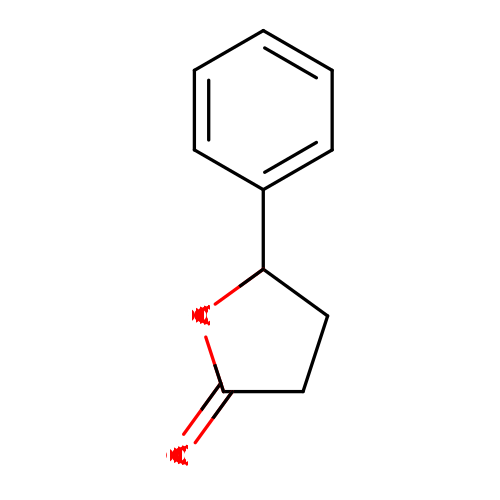
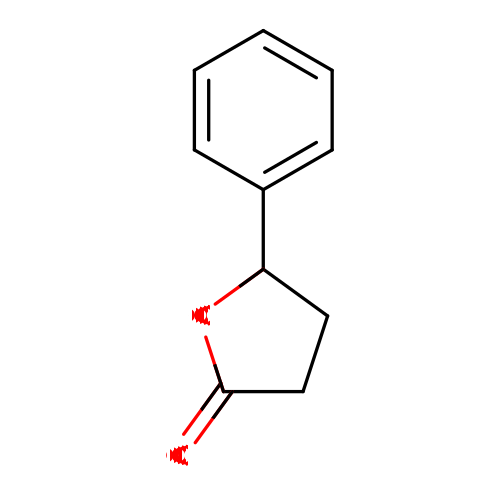
Common Namegamma-Phenyl-gamma-butyrolactone
Description1008-76-0 belongs to the class of organic compounds known as gamma butyrolactones. Gamma butyrolactones are compounds containing a gamma butyrolactone moiety, which consists of an aliphatic five-member ring with four carbon atoms, one oxygen atom, and bears a ketone group on the carbon adjacent to the oxygen atom. Based on a literature review very few articles have been published on 1008-76-0.
Structure
Thumb
SynonymsNot Available
Chemical FormulaC10H10O2
Average Molecular Weight162.188
Monoisotopic Molecular Weight162.068079562
IUPAC Name5-phenyloxolan-2-one
Traditional Name5-phenyloxolan-2-one
CAS Registry NumberNot Available
SMILES
O=C1CCC(O1)C1=CC=CC=C1
InChI Identifier
InChI=1S/C10H10O2/c11-10-7-6-9(12-10)8-4-2-1-3-5-8/h1-5,9H,6-7H2
InChI KeyAEUULUMEYIPECD-UHFFFAOYSA-N
Chemical Taxonomy
Description Belongs to the class of organic compounds known as gamma butyrolactones. Gamma butyrolactones are compounds containing a gamma butyrolactone moiety, which consists of an aliphatic five-member ring with four carbon atoms, one oxygen atom, and bears a ketone group on the carbon adjacent to the oxygen atom.
KingdomOrganic compounds
Super ClassOrganoheterocyclic compounds
ClassLactones
Sub ClassGamma butyrolactones
Direct ParentGamma butyrolactones
Alternative Parents
Substituents
  • Benzenoid
  • Gamma butyrolactone
  • Monocyclic benzene moiety
  • Tetrahydrofuran
  • Carboxylic acid ester
  • Oxacycle
  • Monocarboxylic acid or derivatives
  • Carboxylic acid derivative
  • Organic oxygen compound
  • Organic oxide
  • Hydrocarbon derivative
  • Organooxygen compound
  • Carbonyl group
  • Aromatic heteromonocyclic compound
Molecular FrameworkAromatic heteromonocyclic compounds
External DescriptorsNot Available
Ontology
Not AvailableNot Available
Physical Properties
StateNot Available
Experimental Molecular Properties
PropertyValueReference
Melting PointNot AvailableNot Available
Boiling PointNot AvailableNot Available
Water SolubilityNot AvailableNot Available
LogPNot AvailableNot Available
Experimental Chromatographic PropertiesNot Available
Predicted Molecular Properties
PropertyValueSource
logP1.93ChemAxon
pKa (Strongest Basic)-7.1ChemAxon
Physiological Charge0ChemAxon
Hydrogen Acceptor Count1ChemAxon
Hydrogen Donor Count0ChemAxon
Polar Surface Area26.3 ŲChemAxon
Rotatable Bond Count1ChemAxon
Refractivity44.59 m³·mol⁻¹ChemAxon
Polarizability16.86 ųChemAxon
Number of Rings2ChemAxon
BioavailabilityYesChemAxon
Rule of FiveYesChemAxon
Ghose FilterYesChemAxon
Veber's RuleYesChemAxon
MDDR-like RuleNoChemAxon
Predicted Chromatographic Properties

Predicted Retention Times

Not Available

Predicted Kovats Retention Indices

Not Available
Spectra
Biological Properties
Cellular LocationsNot Available
Biospecimen Locations
  • Blood
  • Urine
Tissue LocationsNot Available
Pathways
Normal Concentrations
Not Available
Abnormal Concentrations
BiospecimenStatusValueAgeSexConditionReferenceDetails
BloodExpected but not QuantifiedNot QuantifiedNot SpecifiedNot SpecifiedCancer patients undergoing total body irradiation details
UrineDetected but not QuantifiedNot QuantifiedNot SpecifiedNot SpecifiedCancer patients undergoing total body irradiation details
Associated Disorders and Diseases
Disease ReferencesNone
Associated OMIM IDsNone
DrugBank IDNot Available
Phenol Explorer Compound IDNot Available
FooDB IDNot Available
KNApSAcK IDNot Available
Chemspider ID13283
KEGG Compound IDNot Available
BioCyc IDNot Available
BiGG IDNot Available
Wikipedia LinkNot Available
METLIN IDNot Available
PubChem Compound13884
PDB IDNot Available
ChEBI IDNot Available
Food Biomarker OntologyNot Available
VMH IDNot Available
MarkerDB IDNot Available
Good Scents IDNot Available
References
Synthesis ReferenceNot Available
Material Safety Data Sheet (MSDS)Not Available
General References
  1. Simon-Manso Y, Marupaka R, Yan X, Liang Y, Telu KH, Mirokhin Y, Stein SE: Mass Spectrometry Fingerprints of Small-Molecule Metabolites in Biofluids: Building a Spectral Library of Recurrent Spectra for Urine Analysis. Anal Chem. 2019 Sep 17;91(18):12021-12029. doi: 10.1021/acs.analchem.9b02977. Epub 2019 Aug 30. [PubMed:31424920 ]