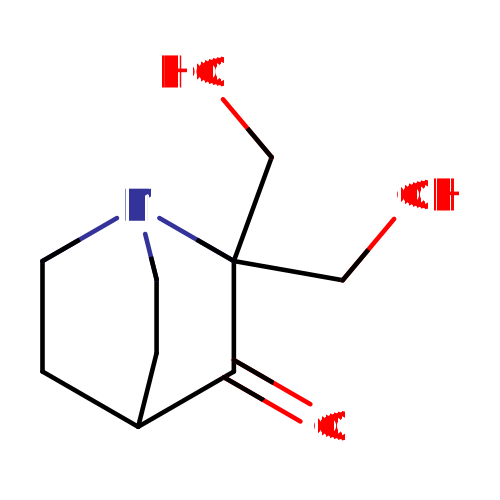
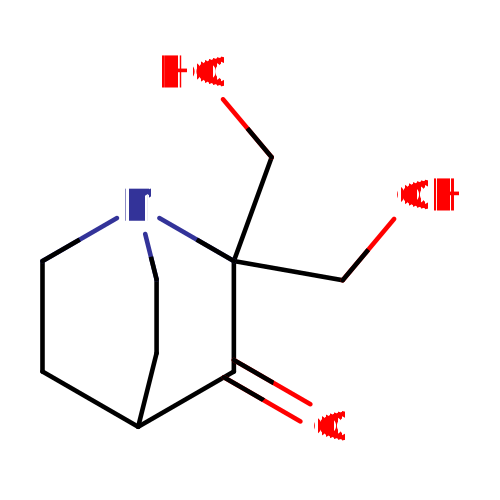
Mrv1652309092222332D

 13 14  0  0  0  0            999 V2000
    1.0030    0.3834    0.0000 C   0  0  0  0  0  0  0  0  0  0  0  0
    1.0030    0.9334    0.0000 C   0  0  0  0  0  0  0  0  0  0  0  0
    1.1405    1.4834    0.0000 N   0  0  0  0  0  0  0  0  0  0  0  0
    0.4260    1.0709    0.0000 C   0  0  0  0  0  0  0  0  0  0  0  0
    0.4260    0.2459    0.0000 C   0  0  0  0  0  0  0  0  0  0  0  0
    1.1405   -0.1666    0.0000 C   0  0  0  0  0  0  0  0  0  0  0  0
    1.8549    0.2459    0.0000 C   0  0  0  0  0  0  0  0  0  0  0  0
    2.5694   -0.1666    0.0000 O   0  0  0  0  0  0  0  0  0  0  0  0
    1.8549    1.0709    0.0000 C   0  0  0  0  0  0  0  0  0  0  0  0
    2.6794    1.0997    0.0000 C   0  0  0  0  0  0  0  0  0  0  0  0
    3.0667    1.8282    0.0000 O   0  0  0  0  0  0  0  0  0  0  0  0
    2.2921    1.7706    0.0000 C   0  0  0  0  0  0  0  0  0  0  0  0
    1.9048    2.4990    0.0000 O   0  0  0  0  0  0  0  0  0  0  0  0
  1  2  1  0  0  0  0
  2  3  1  0  0  0  0
  3  4  1  0  0  0  0
  4  5  1  0  0  0  0
  5  6  1  0  0  0  0
  1  6  1  0  0  0  0
  6  7  1  0  0  0  0
  7  8  2  0  0  0  0
  7  9  1  0  0  0  0
  3  9  1  0  0  0  0
  9 10  1  0  0  0  0
 10 11  1  0  0  0  0
  9 12  1  0  0  0  0
 12 13  1  0  0  0  0
M  END
> <DATABASE_ID>
HMDB0341243
> <DATABASE_NAME>
hmdb
> <SMILES>
OCC1(CO)N2CCC(CC2)C1=O
> <INCHI_IDENTIFIER>
InChI=1S/C9H15NO3/c11-5-9(6-12)8(13)7-1-3-10(9)4-2-7/h7,11-12H,1-6H2
> <INCHI_KEY>
RFBVBRVVOPAAFS-UHFFFAOYSA-N
> <FORMULA>
C9H15NO3
> <MOLECULAR_WEIGHT>
185.223
> <EXACT_MASS>
185.105193347
> <JCHEM_ACCEPTOR_COUNT>
4
> <JCHEM_ATOM_COUNT>
28
> <JCHEM_AVERAGE_POLARIZABILITY>
18.90978600111226
> <JCHEM_BIOAVAILABILITY>
1
> <JCHEM_DONOR_COUNT>
2
> <JCHEM_FORMAL_CHARGE>
0
> <JCHEM_GHOSE_FILTER>
0
> <JCHEM_IUPAC>
2,2-bis(hydroxymethyl)-1-azabicyclo[2.2.2]octan-3-one
> <JCHEM_LOGP>
-0.7980551490000001
> <JCHEM_MDDR_LIKE_RULE>
0
> <JCHEM_NUMBER_OF_RINGS>
2
> <JCHEM_PHYSIOLOGICAL_CHARGE>
0
> <JCHEM_PKA>
14.931979527096463
> <JCHEM_PKA_STRONGEST_ACIDIC>
14.233834440261045
> <JCHEM_PKA_STRONGEST_BASIC>
5.692132944297815
> <JCHEM_POLAR_SURFACE_AREA>
60.77000000000001
> <JCHEM_REFRACTIVITY>
47.656600000000005
> <JCHEM_ROTATABLE_BOND_COUNT>
2
> <JCHEM_RULE_OF_FIVE>
1
> <JCHEM_TRADITIONAL_IUPAC>
2,2-bis(hydroxymethyl)-1-azabicyclo[2.2.2]octan-3-one
> <JCHEM_VEBER_RULE>
0
$$$$