| Record Information |
|---|
| Version | 5.0 |
|---|
| Status | Detected but not Quantified |
|---|
| Creation Date | 2022-09-09 19:46:13 UTC |
|---|
| Update Date | 2022-09-22 18:34:40 UTC |
|---|
| HMDB ID | HMDB0341219 |
|---|
| Secondary Accession Numbers | None |
|---|
| Metabolite Identification |
|---|
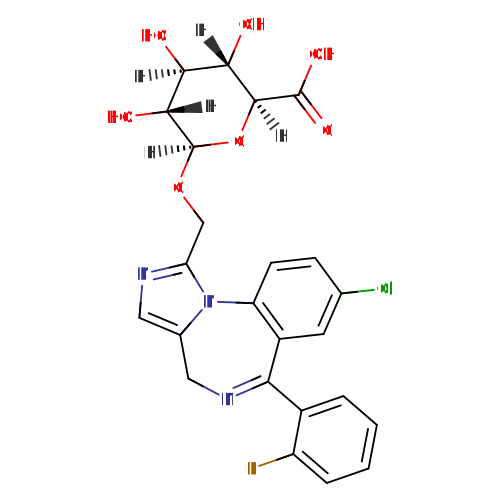
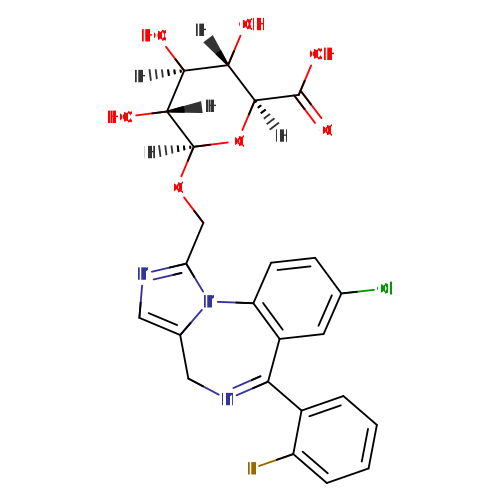
| Common Name | 1'-Hydroxymidazolam beta-D-glucuronide |
|---|
| Description | 1'-Hydroxymidazolam beta-D-glucuronide, also known as 1'-OH MDZ glucuronide, belongs to the class of organic compounds known as imidazo[1,5-a][1,4]benzodiazepines. Imidazo[1,5-a][1,4]benzodiazepines are compounds containing an imidazole ring and a 1,4-benzodiazepine ring system, both sharing one nitrogen atom. 1'-Hydroxymidazolam beta-D-glucuronide is a secondary metabolite. Secondary metabolites are metabolically or physiologically non-essential metabolites that may serve a role as defense or signalling molecules. In some cases they are simply molecules that arise from the incomplete metabolism of other secondary metabolites. Based on a literature review a significant number of articles have been published on 1'-Hydroxymidazolam beta-D-glucuronide. |
|---|
| Structure | [H][C@@]1(OCC2=NC=C3CN=C(C4=CC=CC=C4F)C4=C(C=CC(Cl)=C4)N23)O[C@]([H])(C(O)=O)[C@@]([H])(O)[C@]([H])(O)[C@@]1([H])O InChI=1S/C24H21ClFN3O7/c25-11-5-6-16-14(7-11)18(13-3-1-2-4-15(13)26)28-9-12-8-27-17(29(12)16)10-35-24-21(32)19(30)20(31)22(36-24)23(33)34/h1-8,19-22,24,30-32H,9-10H2,(H,33,34)/t19-,20-,21+,22-,24+/m0/s1 |
|---|
| Synonyms | | Value | Source |
|---|
| 1'-Hydroxymidazolam-glucuronide | ChEBI | | 1'-OH MDZ Glucuronide | ChEBI | | 1-Hydroxymethylmidazolam glucuronide | ChEBI | | 1-Hydroxymidazolam glucuronide | ChEBI | | MDZ-Glucuronide | ChEBI | | 1'-Hydroxymidazolam b-D-glucuronide | Generator | | 1'-Hydroxymidazolam β-D-glucuronide | Generator |
|
|---|
| Chemical Formula | C24H21ClFN3O7 |
|---|
| Average Molecular Weight | 517.89 |
|---|
| Monoisotopic Molecular Weight | 517.1052059 |
|---|
| IUPAC Name | (2S,3S,4S,5R,6R)-6-{[12-chloro-9-(2-fluorophenyl)-2,4,8-triazatricyclo[8.4.0.0^{2,6}]tetradeca-1(10),3,5,8,11,13-hexaen-3-yl]methoxy}-3,4,5-trihydroxyoxane-2-carboxylic acid |
|---|
| Traditional Name | (2S,3S,4S,5R,6R)-6-{[12-chloro-9-(2-fluorophenyl)-2,4,8-triazatricyclo[8.4.0.0^{2,6}]tetradeca-1(10),3,5,8,11,13-hexaen-3-yl]methoxy}-3,4,5-trihydroxyoxane-2-carboxylic acid |
|---|
| CAS Registry Number | Not Available |
|---|
| SMILES | [H][C@@]1(OCC2=NC=C3CN=C(C4=CC=CC=C4F)C4=C(C=CC(Cl)=C4)N23)O[C@]([H])(C(O)=O)[C@@]([H])(O)[C@]([H])(O)[C@@]1([H])O |
|---|
| InChI Identifier | InChI=1S/C24H21ClFN3O7/c25-11-5-6-16-14(7-11)18(13-3-1-2-4-15(13)26)28-9-12-8-27-17(29(12)16)10-35-24-21(32)19(30)20(31)22(36-24)23(33)34/h1-8,19-22,24,30-32H,9-10H2,(H,33,34)/t19-,20-,21+,22-,24+/m0/s1 |
|---|
| InChI Key | ICIUMXQTLQXWGL-QMDPOKHVSA-N |
|---|
| Chemical Taxonomy |
|---|
| Description | Belongs to the class of organic compounds known as imidazo[1,5-a][1,4]benzodiazepines. Imidazo[1,5-a][1,4]benzodiazepines are compounds containing an imidazole ring and a 1,4-benzodiazepine ring system, both sharing one nitrogen atom. |
|---|
| Kingdom | Organic compounds |
|---|
| Super Class | Organoheterocyclic compounds |
|---|
| Class | Benzodiazepines |
|---|
| Sub Class | 1,4-benzodiazepines |
|---|
| Direct Parent | Imidazo[1,5-a][1,4]benzodiazepines |
|---|
| Alternative Parents | |
|---|
| Substituents | - 1-o-glucuronide
- O-glucuronide
- Imidazo[1,5-a][1,4]benzodiazepine
- Glucuronic acid or derivatives
- Hexose monosaccharide
- O-glycosyl compound
- Glycosyl compound
- Para-diazepine
- Halobenzene
- Beta-hydroxy acid
- Fluorobenzene
- Aryl chloride
- Aryl fluoride
- Aryl halide
- Benzenoid
- Monocyclic benzene moiety
- Pyran
- Oxane
- Hydroxy acid
- Monosaccharide
- N-substituted imidazole
- Azole
- Imidazole
- Heteroaromatic compound
- Secondary alcohol
- Ketimine
- Oxacycle
- Azacycle
- Carboxylic acid derivative
- Carboxylic acid
- Organic 1,3-dipolar compound
- Propargyl-type 1,3-dipolar organic compound
- Polyol
- Acetal
- Monocarboxylic acid or derivatives
- Organic oxygen compound
- Alcohol
- Carbonyl group
- Organochloride
- Organopnictogen compound
- Organic nitrogen compound
- Organic oxide
- Organooxygen compound
- Organonitrogen compound
- Organofluoride
- Imine
- Hydrocarbon derivative
- Organohalogen compound
- Aromatic heteropolycyclic compound
|
|---|
| Molecular Framework | Aromatic heteropolycyclic compounds |
|---|
| External Descriptors | Not Available |
|---|
| Ontology |
|---|
| Not Available | Not Available |
|---|
| Physical Properties |
|---|
| State | Not Available |
|---|
| Experimental Molecular Properties | | Property | Value | Reference |
|---|
| Melting Point | Not Available | Not Available | | Boiling Point | Not Available | Not Available | | Water Solubility | Not Available | Not Available | | LogP | Not Available | Not Available |
|
|---|
| Experimental Chromatographic Properties | Not Available |
|---|
| Predicted Molecular Properties | |
|---|
| Predicted Chromatographic Properties | Predicted Retention Times Not AvailablePredicted Kovats Retention IndicesNot Available |
|---|