| Record Information |
|---|
| Version | 5.0 |
|---|
| Status | Detected but not Quantified |
|---|
| Creation Date | 2021-09-11 01:08:05 UTC |
|---|
| Update Date | 2021-09-26 22:57:58 UTC |
|---|
| HMDB ID | HMDB0247980 |
|---|
| Secondary Accession Numbers | None |
|---|
| Metabolite Identification |
|---|
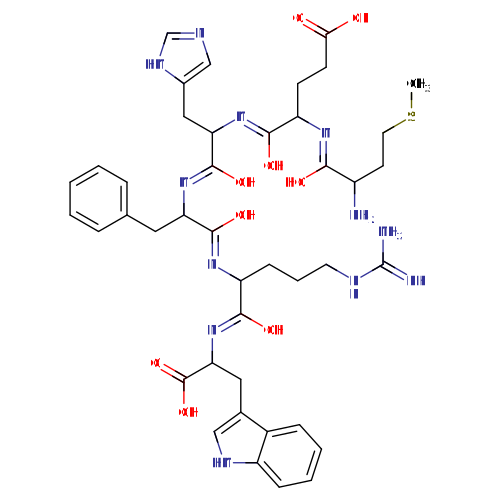
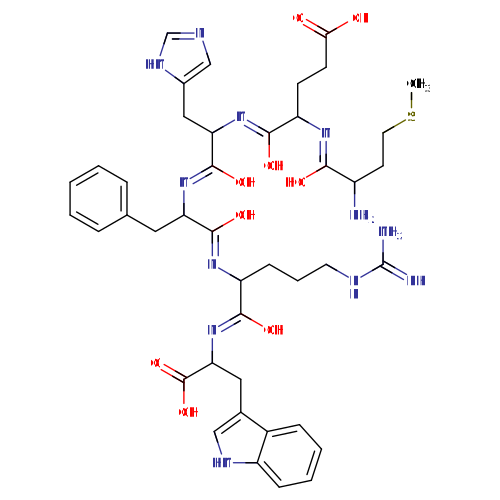
| Common Name | L-Tryptophan, N-(N(2)-(N-(N-(N-L-methionyl-L-alpha-glutamyl)-L-histidyl)-L-phenylalanyl)-L-arginyl)- |
|---|
| Description | L-Tryptophan, N-(N(2)-(N-(N-(N-L-methionyl-L-alpha-glutamyl)-L-histidyl)-L-phenylalanyl)-L-arginyl)- belongs to the class of organic compounds known as oligopeptides. These are organic compounds containing a sequence of between three and ten alpha-amino acids joined by peptide bonds. Based on a literature review very few articles have been published on L-Tryptophan, N-(N(2)-(N-(N-(N-L-methionyl-L-alpha-glutamyl)-L-histidyl)-L-phenylalanyl)-L-arginyl)-. This compound has been identified in human blood as reported by (PMID: 31557052 ). L-tryptophan, n-(n(2)-(n-(n-(n-l-methionyl-l-alpha-glutamyl)-l-histidyl)-l-phenylalanyl)-l-arginyl)- is not a naturally occurring metabolite and is only found in those individuals exposed to this compound or its derivatives. Technically L-Tryptophan, N-(N(2)-(N-(N-(N-L-methionyl-L-alpha-glutamyl)-L-histidyl)-L-phenylalanyl)-L-arginyl)- is part of the human exposome. The exposome can be defined as the collection of all the exposures of an individual in a lifetime and how those exposures relate to health. An individual's exposure begins before birth and includes insults from environmental and occupational sources. |
|---|
| Structure | CSCCC(N)C(=O)NC(CCC(O)=O)C(=O)NC(CC1=CN=CN1)C(=O)NC(CC1=CC=CC=C1)C(=O)NC(CCCN=C(N)N)C(=O)NC(CC1=CNC2=CC=CC=C12)C(O)=O InChI=1S/C42H56N12O9S/c1-64-17-15-28(43)36(57)50-31(13-14-35(55)56)38(59)53-33(20-26-22-46-23-49-26)40(61)52-32(18-24-8-3-2-4-9-24)39(60)51-30(12-7-16-47-42(44)45)37(58)54-34(41(62)63)19-25-21-48-29-11-6-5-10-27(25)29/h2-6,8-11,21-23,28,30-34,48H,7,12-20,43H2,1H3,(H,46,49)(H,50,57)(H,51,60)(H,52,61)(H,53,59)(H,54,58)(H,55,56)(H,62,63)(H4,44,45,47) |
|---|
| Synonyms | Not Available |
|---|
| Chemical Formula | C42H56N12O9S |
|---|
| Average Molecular Weight | 905.05 |
|---|
| Monoisotopic Molecular Weight | 904.401392605 |
|---|
| IUPAC Name | 4-[2-amino-4-(methylsulfanyl)butanamido]-4-{[1-({1-[(1-{[1-carboxy-2-(1H-indol-3-yl)ethyl]carbamoyl}-4-[(diaminomethylidene)amino]butyl)carbamoyl]-2-phenylethyl}carbamoyl)-2-(1H-imidazol-5-yl)ethyl]carbamoyl}butanoic acid |
|---|
| Traditional Name | 4-[2-amino-4-(methylsulfanyl)butanamido]-4-{[1-({1-[(1-{[1-carboxy-2-(1H-indol-3-yl)ethyl]carbamoyl}-4-[(diaminomethylidene)amino]butyl)carbamoyl]-2-phenylethyl}carbamoyl)-2-(3H-imidazol-4-yl)ethyl]carbamoyl}butanoic acid |
|---|
| CAS Registry Number | Not Available |
|---|
| SMILES | CSCCC(N)C(=O)NC(CCC(O)=O)C(=O)NC(CC1=CN=CN1)C(=O)NC(CC1=CC=CC=C1)C(=O)NC(CCCN=C(N)N)C(=O)NC(CC1=CNC2=CC=CC=C12)C(O)=O |
|---|
| InChI Identifier | InChI=1S/C42H56N12O9S/c1-64-17-15-28(43)36(57)50-31(13-14-35(55)56)38(59)53-33(20-26-22-46-23-49-26)40(61)52-32(18-24-8-3-2-4-9-24)39(60)51-30(12-7-16-47-42(44)45)37(58)54-34(41(62)63)19-25-21-48-29-11-6-5-10-27(25)29/h2-6,8-11,21-23,28,30-34,48H,7,12-20,43H2,1H3,(H,46,49)(H,50,57)(H,51,60)(H,52,61)(H,53,59)(H,54,58)(H,55,56)(H,62,63)(H4,44,45,47) |
|---|
| InChI Key | CLUQWSRYSHBBDD-UHFFFAOYSA-N |
|---|
| Chemical Taxonomy |
|---|
| Description | Belongs to the class of organic compounds known as oligopeptides. These are organic compounds containing a sequence of between three and ten alpha-amino acids joined by peptide bonds. |
|---|
| Kingdom | Organic compounds |
|---|
| Super Class | Organic acids and derivatives |
|---|
| Class | Carboxylic acids and derivatives |
|---|
| Sub Class | Amino acids, peptides, and analogues |
|---|
| Direct Parent | Oligopeptides |
|---|
| Alternative Parents | |
|---|
| Substituents | - Alpha-oligopeptide
- Phenylalanine or derivatives
- Histidine or derivatives
- Glutamic acid or derivatives
- Methionine or derivatives
- N-acyl-alpha-amino acid
- N-acyl-alpha amino acid or derivatives
- Alpha-amino acid amide
- N-substituted-alpha-amino acid
- Alpha-amino acid or derivatives
- Amphetamine or derivatives
- 3-alkylindole
- Indole
- Indole or derivatives
- Imidazolyl carboxylic acid derivative
- Monocyclic benzene moiety
- Dicarboxylic acid or derivatives
- Fatty amide
- N-acyl-amine
- Fatty acyl
- Substituted pyrrole
- Benzenoid
- Azole
- Imidazole
- Heteroaromatic compound
- Pyrrole
- Amino acid
- Secondary carboxylic acid amide
- Amino acid or derivatives
- Guanidine
- Carboxamide group
- Dialkylthioether
- Organoheterocyclic compound
- Sulfenyl compound
- Carboximidamide
- Azacycle
- Thioether
- Organic 1,3-dipolar compound
- Propargyl-type 1,3-dipolar organic compound
- Carboxylic acid
- Organosulfur compound
- Organic oxygen compound
- Organic oxide
- Carbonyl group
- Organic nitrogen compound
- Hydrocarbon derivative
- Primary aliphatic amine
- Amine
- Primary amine
- Organonitrogen compound
- Organooxygen compound
- Aromatic heteropolycyclic compound
|
|---|
| Molecular Framework | Aromatic heteropolycyclic compounds |
|---|
| External Descriptors | Not Available |
|---|
| Ontology |
|---|
| Physiological effect | Not Available |
|---|
| Disposition | |
|---|
| Process | Not Available |
|---|
| Role | Not Available |
|---|
| Physical Properties |
|---|
| State | Not Available |
|---|
| Experimental Molecular Properties | | Property | Value | Reference |
|---|
| Melting Point | Not Available | Not Available | | Boiling Point | Not Available | Not Available | | Water Solubility | Not Available | Not Available | | LogP | Not Available | Not Available |
|
|---|
| Experimental Chromatographic Properties | Not Available |
|---|
| Predicted Molecular Properties | |
|---|
| Predicted Chromatographic Properties | Predicted Collision Cross Sections| Predictor | Adduct Type | CCS Value (Å2) | Reference |
|---|
| DeepCCS | [M-2H]- | 311.875 | 30932474 | | DeepCCS | [M+Na]+ | 285.779 | 30932474 |
Predicted Retention Times Underivatized| Chromatographic Method | Retention Time | Reference |
|---|
| Predicted by Siyang on May 30, 2022 | 13.4904 minutes | 33406817 | | Predicted by Siyang using ReTip algorithm on June 8, 2022 | 7.61 minutes | 32390414 | | Fem_Long = Waters ACQUITY UPLC HSS T3 C18 with Water:MeOH and 0.1% Formic Acid | 1088.9 seconds | 40023050 | | Fem_Lipids = Ascentis Express C18 with (60:40 water:ACN):(90:10 IPA:ACN) and 10mM NH4COOH + 0.1% Formic Acid | 179.5 seconds | 40023050 | | Life_Old = Waters ACQUITY UPLC BEH C18 with Water:(20:80 acetone:ACN) and 0.1% Formic Acid | 164.0 seconds | 40023050 | | Life_New = RP Waters ACQUITY UPLC HSS T3 C18 with Water:(30:70 MeOH:ACN) and 0.1% Formic Acid | 187.0 seconds | 40023050 | | RIKEN = Waters ACQUITY UPLC BEH C18 with Water:ACN and 0.1% Formic Acid | 137.0 seconds | 40023050 | | Eawag_XBridgeC18 = XBridge C18 3.5u 2.1x50 mm with Water:MeOH and 0.1% Formic Acid | 408.7 seconds | 40023050 | | BfG_NTS_RP1 =Agilent Zorbax Eclipse Plus C18 (2.1 mm x 150 mm, 3.5 um) with Water:ACN and 0.1% Formic Acid | 431.6 seconds | 40023050 | | HILIC_BDD_2 = Merck SeQuant ZIC-HILIC with ACN(0.1% formic acid):water(16 mM ammonium formate) | 1423.8 seconds | 40023050 | | UniToyama_Atlantis = RP Waters Atlantis T3 (2.1 x 150 mm, 5 um) with ACN:Water and 0.1% Formic Acid | 931.2 seconds | 40023050 | | BDD_C18 = Hypersil Gold 1.9µm C18 with Water:ACN and 0.1% Formic Acid | 459.2 seconds | 40023050 | | UFZ_Phenomenex = Kinetex Core-Shell C18 2.6 um, 3.0 x 100 mm, Phenomenex with Water:MeOH and 0.1% Formic Acid | 1073.9 seconds | 40023050 | | SNU_RIKEN_POS = Waters ACQUITY UPLC BEH C18 with Water:ACN and 0.1% Formic Acid | 288.9 seconds | 40023050 | | RPMMFDA = Waters ACQUITY UPLC BEH C18 with Water:ACN and 0.1% Formic Acid | 356.2 seconds | 40023050 | | MTBLS87 = Merck SeQuant ZIC-pHILIC column with ACN:Water and :ammonium carbonate | 384.7 seconds | 40023050 | | KI_GIAR_zic_HILIC_pH2_7 = Merck SeQuant ZIC-HILIC with ACN:Water and 0.1% FA | 907.9 seconds | 40023050 | | Meister zic-pHILIC pH9.3 = Merck SeQuant ZIC-pHILIC column with ACN:Water 5mM NH4Ac pH9.3 and 5mM ammonium acetate in water | 240.3 seconds | 40023050 |
Predicted Kovats Retention IndicesNot Available |
|---|
| MS/MS Spectra| Spectrum Type | Description | Splash Key | Deposition Date | Source | View |
|---|
| Predicted LC-MS/MS | Predicted LC-MS/MS Spectrum - L-Tryptophan, N-(N(2)-(N-(N-(N-L-methionyl-L-alpha-glutamyl)-L-histidyl)-L-phenylalanyl)-L-arginyl)- 10V, Positive-QTOF | splash10-0a4i-0000000059-581fb63d8ce2a0179376 | 2021-10-12 | Wishart Lab | View Spectrum | | Predicted LC-MS/MS | Predicted LC-MS/MS Spectrum - L-Tryptophan, N-(N(2)-(N-(N-(N-L-methionyl-L-alpha-glutamyl)-L-histidyl)-L-phenylalanyl)-L-arginyl)- 20V, Positive-QTOF | splash10-052r-0100001091-a3f05c3dece950c0ac30 | 2021-10-12 | Wishart Lab | View Spectrum | | Predicted LC-MS/MS | Predicted LC-MS/MS Spectrum - L-Tryptophan, N-(N(2)-(N-(N-(N-L-methionyl-L-alpha-glutamyl)-L-histidyl)-L-phenylalanyl)-L-arginyl)- 40V, Positive-QTOF | splash10-0j4i-3900000110-29f3cf4cf2b34eb6382a | 2021-10-12 | Wishart Lab | View Spectrum | | Predicted LC-MS/MS | Predicted LC-MS/MS Spectrum - L-Tryptophan, N-(N(2)-(N-(N-(N-L-methionyl-L-alpha-glutamyl)-L-histidyl)-L-phenylalanyl)-L-arginyl)- 10V, Negative-QTOF | splash10-0udi-1000000049-6f1c96e19d782fa64b87 | 2021-10-12 | Wishart Lab | View Spectrum | | Predicted LC-MS/MS | Predicted LC-MS/MS Spectrum - L-Tryptophan, N-(N(2)-(N-(N-(N-L-methionyl-L-alpha-glutamyl)-L-histidyl)-L-phenylalanyl)-L-arginyl)- 20V, Negative-QTOF | splash10-0zfv-2000001950-196eb4be958c3f0979bd | 2021-10-12 | Wishart Lab | View Spectrum | | Predicted LC-MS/MS | Predicted LC-MS/MS Spectrum - L-Tryptophan, N-(N(2)-(N-(N-(N-L-methionyl-L-alpha-glutamyl)-L-histidyl)-L-phenylalanyl)-L-arginyl)- 40V, Negative-QTOF | splash10-000i-3491211110-29693913847259791b69 | 2021-10-12 | Wishart Lab | View Spectrum |
NMR Spectra| Spectrum Type | Description | Deposition Date | Source | View |
|---|
| Predicted 1D NMR | 13C NMR Spectrum (1D, 100 MHz, D2O, predicted) | 2021-10-13 | Wishart Lab | View Spectrum | | Predicted 1D NMR | 1H NMR Spectrum (1D, 100 MHz, D2O, predicted) | 2021-10-13 | Wishart Lab | View Spectrum | | Predicted 1D NMR | 1H NMR Spectrum (1D, 1000 MHz, D2O, predicted) | 2021-10-13 | Wishart Lab | View Spectrum | | Predicted 1D NMR | 13C NMR Spectrum (1D, 1000 MHz, D2O, predicted) | 2021-10-13 | Wishart Lab | View Spectrum | | Predicted 1D NMR | 1H NMR Spectrum (1D, 200 MHz, D2O, predicted) | 2021-10-13 | Wishart Lab | View Spectrum | | Predicted 1D NMR | 13C NMR Spectrum (1D, 200 MHz, D2O, predicted) | 2021-10-13 | Wishart Lab | View Spectrum | | Predicted 1D NMR | 13C NMR Spectrum (1D, 300 MHz, D2O, predicted) | 2021-10-13 | Wishart Lab | View Spectrum | | Predicted 1D NMR | 1H NMR Spectrum (1D, 300 MHz, D2O, predicted) | 2021-10-13 | Wishart Lab | View Spectrum | | Predicted 1D NMR | 13C NMR Spectrum (1D, 400 MHz, D2O, predicted) | 2021-10-13 | Wishart Lab | View Spectrum | | Predicted 1D NMR | 1H NMR Spectrum (1D, 400 MHz, D2O, predicted) | 2021-10-13 | Wishart Lab | View Spectrum | | Predicted 1D NMR | 13C NMR Spectrum (1D, 500 MHz, D2O, predicted) | 2021-10-13 | Wishart Lab | View Spectrum | | Predicted 1D NMR | 1H NMR Spectrum (1D, 500 MHz, D2O, predicted) | 2021-10-13 | Wishart Lab | View Spectrum | | Predicted 1D NMR | 1H NMR Spectrum (1D, 600 MHz, D2O, predicted) | 2021-10-13 | Wishart Lab | View Spectrum | | Predicted 1D NMR | 13C NMR Spectrum (1D, 600 MHz, D2O, predicted) | 2021-10-13 | Wishart Lab | View Spectrum | | Predicted 1D NMR | 1H NMR Spectrum (1D, 700 MHz, D2O, predicted) | 2021-10-13 | Wishart Lab | View Spectrum | | Predicted 1D NMR | 13C NMR Spectrum (1D, 700 MHz, D2O, predicted) | 2021-10-13 | Wishart Lab | View Spectrum | | Predicted 1D NMR | 13C NMR Spectrum (1D, 800 MHz, D2O, predicted) | 2021-10-13 | Wishart Lab | View Spectrum | | Predicted 1D NMR | 1H NMR Spectrum (1D, 800 MHz, D2O, predicted) | 2021-10-13 | Wishart Lab | View Spectrum | | Predicted 1D NMR | 1H NMR Spectrum (1D, 900 MHz, D2O, predicted) | 2021-10-13 | Wishart Lab | View Spectrum | | Predicted 1D NMR | 13C NMR Spectrum (1D, 900 MHz, D2O, predicted) | 2021-10-13 | Wishart Lab | View Spectrum |
|
|---|