| Record Information |
|---|
| Version | 5.0 |
|---|
| Status | Predicted |
|---|
| Creation Date | 2021-03-31 16:54:38 UTC |
|---|
| Update Date | 2022-10-24 19:44:22 UTC |
|---|
| HMDB ID | HMDB0240850 |
|---|
| Secondary Accession Numbers | None |
|---|
| Metabolite Identification |
|---|
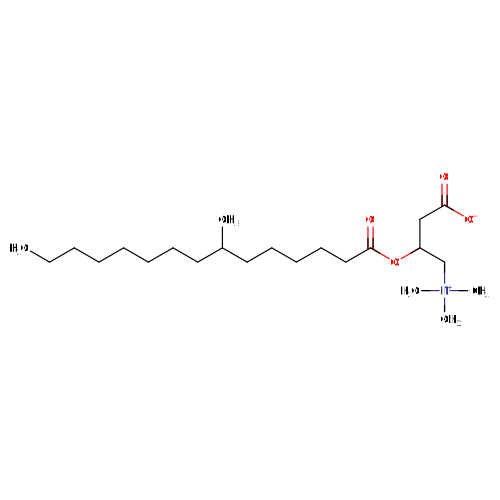
| Common Name | 7-Methylpentadecanoylcarnitine |
|---|
| Description | 7-Methylpentadecanoylcarnitine is an acylcarnitine. More specifically, it is an 7-methylpentadecanoic acid ester of carnitine. Acylcarnitines were first discovered more than 70 year ago (PMID: 13825279 ). It is believed that there are more than 1000 types of acylcarnitines in the human body. The general role of acylcarnitines is to transport acyl-groups (organic acids and fatty acids) from the cytoplasm into the mitochondria so that they can be broken down to produce energy. This process is known as beta-oxidation. According to a recent review (PMID: 35710135 ), acylcarnitines (ACs) can be classified into 9 different categories depending on the type and size of their acyl-group: 1) short-chain ACs; 2) medium-chain ACs; 3) long-chain ACs; 4) very long-chain ACs; 5) hydroxy ACs; 6) branched chain ACs; 7) unsaturated ACs; 8) dicarboxylic ACs and 9) miscellaneous ACs. Short-chain ACs have acyl-groups with two to five carbons (C2-C5), medium-chain ACs have acyl-groups with six to thirteen carbons (C6-C13), long-chain ACs have acyl-groups with fourteen to twenty once carbons (C14-C21) and very long-chain ACs have acyl groups with more than 22 carbons. 7-Methylpentadecanoylcarnitine is therefore classified as a long chain AC. As a long-chain acylcarnitine 7-Methylpentadecanoylcarnitine is generally formed through esterification with long-chain fatty acids obtained from the diet. The main function of most long-chain acylcarnitines is to ensure long chain fatty acid transport into the mitochondria (PMID: 22804748 ). Altered levels of long-chain acylcarnitines can serve as useful markers for inherited disorders of long-chain fatty acid metabolism. Carnitine palmitoyltransferase I (CPT I, EC:2.3.1.21) is involved in the synthesis of long-chain acylcarnitines (more than C12) on the mitochondrial outer membrane. Elevated serum/plasma levels of long-chain acylcarnitines are not only markers for incomplete FA oxidation but also are indicators of altered carbohydrate and lipid metabolism. High serum concentrations of long-chain acylcarnitines in the postprandial or fed state are markers of insulin resistance and arise from insulin's inability to inhibit CPT-1-dependent fatty acid metabolism in muscles and the heart (PMID: 19073774 ). Increased intracellular content of long-chain acylcarnitines is thought to serve as a feedback inhibition mechanism of insulin action (PMID: 23258903 ). In healthy subjects, increased concentrations of insulin effectively inhibits long-chain acylcarnitine production. Several studies have also found increased levels of circulating long-chain acylcarnitines in chronic heart failure patients (PMID: 26796394 ). The study of acylcarnitines is an active area of research and it is likely that many novel acylcarnitines will be discovered in the coming years. It is also likely that many novel roles in health and disease will be uncovered. An excellent review of the current state of knowledge for acylcarnitines is available (PMID: 35710135 ). |
|---|
| Structure | |
|---|
| Synonyms | Not Available |
|---|
| Chemical Formula | C23H45NO4 |
|---|
| Average Molecular Weight | 399.616 |
|---|
| Monoisotopic Molecular Weight | 399.334858933 |
|---|
| IUPAC Name | Not Available |
|---|
| Traditional Name | Not Available |
|---|
| CAS Registry Number | Not Available |
|---|
| SMILES | Not Available |
|---|
| InChI Identifier | InChI=1S/C23H45NO4/c1-6-7-8-9-10-12-15-20(2)16-13-11-14-17-23(27)28-21(18-22(25)26)19-24(3,4)5/h20-21H,6-19H2,1-5H3 |
|---|
| InChI Key | UDLGUPBNVNGINY-UHFFFAOYSA-N |
|---|
| Chemical Taxonomy |
|---|
| Classification | Not classified |
|---|
| Ontology |
|---|
| Physiological effect | |
|---|
| Disposition | |
|---|
| Process | Not Available |
|---|
| Role | |
|---|
| Physical Properties |
|---|
| State | Not Available |
|---|
| Experimental Molecular Properties | | Property | Value | Reference |
|---|
| Melting Point | Not Available | Not Available | | Boiling Point | Not Available | Not Available | | Water Solubility | Not Available | Not Available | | LogP | Not Available | Not Available |
|
|---|
| Experimental Chromatographic Properties |
|---|
| Predicted Molecular Properties | Not Available |
|---|
| Predicted Chromatographic Properties | Predicted Retention Times Underivatized| Chromatographic Method | Retention Time | Reference |
|---|
| Predicted by Siyang on May 30, 2022 | 21.1395 minutes | 33406817 | | Predicted by Siyang using ReTip algorithm on June 8, 2022 | 3.03 minutes | 32390414 | | Fem_Long = Waters ACQUITY UPLC HSS T3 C18 with Water:MeOH and 0.1% Formic Acid | 2843.0 seconds | 40023050 | | Fem_Lipids = Ascentis Express C18 with (60:40 water:ACN):(90:10 IPA:ACN) and 10mM NH4COOH + 0.1% Formic Acid | 299.6 seconds | 40023050 | | Life_Old = Waters ACQUITY UPLC BEH C18 with Water:(20:80 acetone:ACN) and 0.1% Formic Acid | 253.7 seconds | 40023050 | | Life_New = RP Waters ACQUITY UPLC HSS T3 C18 with Water:(30:70 MeOH:ACN) and 0.1% Formic Acid | 187.1 seconds | 40023050 | | RIKEN = Waters ACQUITY UPLC BEH C18 with Water:ACN and 0.1% Formic Acid | 627.6 seconds | 40023050 | | Eawag_XBridgeC18 = XBridge C18 3.5u 2.1x50 mm with Water:MeOH and 0.1% Formic Acid | 981.8 seconds | 40023050 | | BfG_NTS_RP1 =Agilent Zorbax Eclipse Plus C18 (2.1 mm x 150 mm, 3.5 um) with Water:ACN and 0.1% Formic Acid | 903.0 seconds | 40023050 | | HILIC_BDD_2 = Merck SeQuant ZIC-HILIC with ACN(0.1% formic acid):water(16 mM ammonium formate) | 400.9 seconds | 40023050 | | UniToyama_Atlantis = RP Waters Atlantis T3 (2.1 x 150 mm, 5 um) with ACN:Water and 0.1% Formic Acid | 2245.3 seconds | 40023050 | | BDD_C18 = Hypersil Gold 1.9µm C18 with Water:ACN and 0.1% Formic Acid | 617.7 seconds | 40023050 | | UFZ_Phenomenex = Kinetex Core-Shell C18 2.6 um, 3.0 x 100 mm, Phenomenex with Water:MeOH and 0.1% Formic Acid | 2322.8 seconds | 40023050 | | SNU_RIKEN_POS = Waters ACQUITY UPLC BEH C18 with Water:ACN and 0.1% Formic Acid | 513.6 seconds | 40023050 | | RPMMFDA = Waters ACQUITY UPLC BEH C18 with Water:ACN and 0.1% Formic Acid | 512.3 seconds | 40023050 | | MTBLS87 = Merck SeQuant ZIC-pHILIC column with ACN:Water and :ammonium carbonate | 278.6 seconds | 40023050 | | KI_GIAR_zic_HILIC_pH2_7 = Merck SeQuant ZIC-HILIC with ACN:Water and 0.1% FA | 152.2 seconds | 40023050 | | Meister zic-pHILIC pH9.3 = Merck SeQuant ZIC-pHILIC column with ACN:Water 5mM NH4Ac pH9.3 and 5mM ammonium acetate in water | 8.4 seconds | 40023050 |
Predicted Kovats Retention IndicesUnderivatized |
|---|
| General References | - Blazenovic I, Kind T, Sa MR, Ji J, Vaniya A, Wancewicz B, Roberts BS, Torbasinovic H, Lee T, Mehta SS, Showalter MR, Song H, Kwok J, Jahn D, Kim J, Fiehn O: Structure Annotation of All Mass Spectra in Untargeted Metabolomics. Anal Chem. 2019 Feb 5;91(3):2155-2162. doi: 10.1021/acs.analchem.8b04698. Epub 2019 Jan 16. [PubMed:30608141 ]
- FRITZ IB: Action of carnitine on long chain fatty acid oxidation by liver. Am J Physiol. 1959 Aug;197:297-304. doi: 10.1152/ajplegacy.1959.197.2.297. [PubMed:13825279 ]
- Reuter SE, Evans AM: Carnitine and acylcarnitines: pharmacokinetic, pharmacological and clinical aspects. Clin Pharmacokinet. 2012 Sep 1;51(9):553-72. doi: 10.1007/BF03261931. [PubMed:22804748 ]
- Bruce CR, Hoy AJ, Turner N, Watt MJ, Allen TL, Carpenter K, Cooney GJ, Febbraio MA, Kraegen EW: Overexpression of carnitine palmitoyltransferase-1 in skeletal muscle is sufficient to enhance fatty acid oxidation and improve high-fat diet-induced insulin resistance. Diabetes. 2009 Mar;58(3):550-8. doi: 10.2337/db08-1078. Epub 2008 Dec 10. [PubMed:19073774 ]
- Schooneman MG, Vaz FM, Houten SM, Soeters MR: Acylcarnitines: reflecting or inflicting insulin resistance? Diabetes. 2013 Jan;62(1):1-8. doi: 10.2337/db12-0466. [PubMed:23258903 ]
- Ahmad T, Kelly JP, McGarrah RW, Hellkamp AS, Fiuzat M, Testani JM, Wang TS, Verma A, Samsky MD, Donahue MP, Ilkayeva OR, Bowles DE, Patel CB, Milano CA, Rogers JG, Felker GM, O'Connor CM, Shah SH, Kraus WE: Prognostic Implications of Long-Chain Acylcarnitines in Heart Failure and Reversibility With Mechanical Circulatory Support. J Am Coll Cardiol. 2016 Jan 26;67(3):291-9. doi: 10.1016/j.jacc.2015.10.079. [PubMed:26796394 ]
- Yu D, Zhou L, Xuan Q, Wang L, Zhao X, Lu X, Xu G: Strategy for Comprehensive Identification of Acylcarnitines Based on Liquid Chromatography-High-Resolution Mass Spectrometry. Anal Chem. 2018 May 1;90(9):5712-5718. doi: 10.1021/acs.analchem.7b05471. Epub 2018 Apr 20. [PubMed:29651844 ]
- Yan X, Markey SP, Marupaka R, Dong Q, Cooper BT, Mirokhin YA, Wallace WE, Stein SE: Mass Spectral Library of Acylcarnitines Derived from Human Urine. Anal Chem. 2020 May 5;92(9):6521-6528. doi: 10.1021/acs.analchem.0c00129. Epub 2020 Apr 23. [PubMed:32271007 ]
- Zuniga A, Li L: Ultra-high performance liquid chromatography tandem mass spectrometry for comprehensive analysis of urinary acylcarnitines. Anal Chim Acta. 2011 Mar 9;689(1):77-84. doi: 10.1016/j.aca.2011.01.018. Epub 2011 Jan 18. [PubMed:21338760 ]
- Dambrova M, Makrecka-Kuka M, Kuka J, Vilskersts R, Nordberg D, Attwood MM, Smesny S, Sen ZD, Guo AC, Oler E, Tian S, Zheng J, Wishart DS, Liepinsh E, Schioth HB: Acylcarnitines: Nomenclature, Biomarkers, Therapeutic Potential, Drug Targets, and Clinical Trials. Pharmacol Rev. 2022 Jul;74(3):506-551. doi: 10.1124/pharmrev.121.000408. [PubMed:35710135 ]
|
|---|