| Record Information |
|---|
| Version | 5.0 |
|---|
| Status | Expected but not Quantified |
|---|
| Creation Date | 2012-09-12 00:33:44 UTC |
|---|
| Update Date | 2022-03-07 02:56:06 UTC |
|---|
| HMDB ID | HMDB0039191 |
|---|
| Secondary Accession Numbers | |
|---|
| Metabolite Identification |
|---|
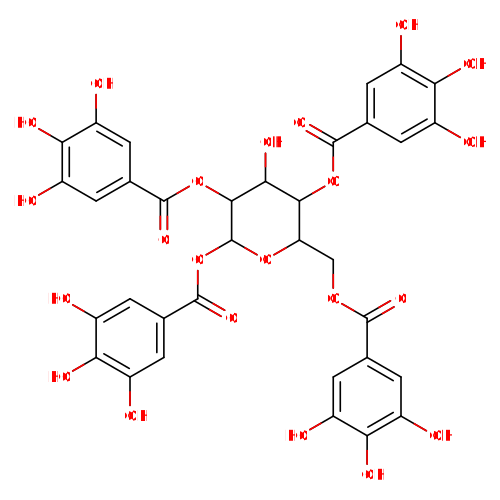
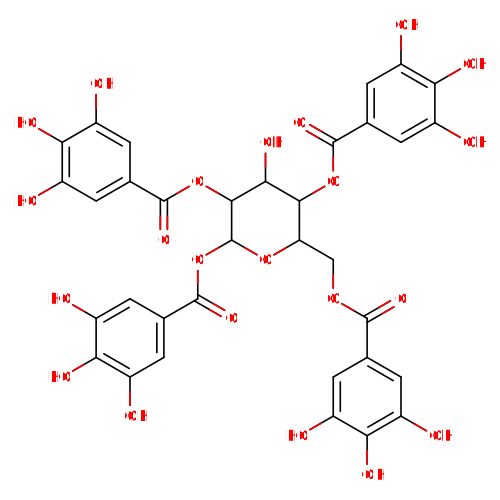
| Common Name | 1,2,4,6-Tetragalloyl-beta-D-glucopyranose |
|---|
| Description | 1,2,4,6-Tetragalloyl-beta-D-glucopyranose belongs to the class of organic compounds known as tannins. These are naturally occurring polyphenols which be categorized into four main classes: hydrolyzable tannin (based on ellagic acid or gallic acid), condensed tannins (made of oligomeric or polymeric proanthocyanidins), complex tannins (made of a catechin bound to a gallotannin or elagitannin), and phlorotannins (oligomers of phloroglucinol). 1,2,4,6-Tetragalloyl-beta-D-glucopyranose has been detected, but not quantified in, several different foods, such as pomegranates (Punica granatum), teas (Camellia sinensis), herbal tea, red tea, and black tea. This could make 1,2,4,6-tetragalloyl-beta-D-glucopyranose a potential biomarker for the consumption of these foods. Based on a literature review very few articles have been published on 1,2,4,6-Tetragalloyl-beta-D-glucopyranose. |
|---|
| Structure | OC1C(OC(=O)C2=CC(O)=C(O)C(O)=C2)C(COC(=O)C2=CC(O)=C(O)C(O)=C2)OC(OC(=O)C2=CC(O)=C(O)C(O)=C2)C1OC(=O)C1=CC(O)=C(O)C(O)=C1 InChI=1S/C34H28O22/c35-14-1-10(2-15(36)23(14)43)30(48)52-9-22-28(54-31(49)11-3-16(37)24(44)17(38)4-11)27(47)29(55-32(50)12-5-18(39)25(45)19(40)6-12)34(53-22)56-33(51)13-7-20(41)26(46)21(42)8-13/h1-8,22,27-29,34-47H,9H2 |
|---|
| Synonyms | | Value | Source |
|---|
| 1,2,4,6-Tetragalloyl-b-D-glucopyranose | Generator | | 1,2,4,6-Tetragalloyl-β-D-glucopyranose | Generator | | 1,2,4,6-Tetra-O-galloyl-beta-D-glucose | HMDB | | [4-Hydroxy-3,5,6-tris(3,4,5-trihydroxybenzoyloxy)oxan-2-yl]methyl 3,4,5-trihydroxybenzoic acid | Generator |
|
|---|
| Chemical Formula | C34H28O22 |
|---|
| Average Molecular Weight | 788.5729 |
|---|
| Monoisotopic Molecular Weight | 788.10722258 |
|---|
| IUPAC Name | 4-hydroxy-5,6-bis(3,4,5-trihydroxybenzoyloxy)-2-[(3,4,5-trihydroxybenzoyloxy)methyl]oxan-3-yl 3,4,5-trihydroxybenzoate |
|---|
| Traditional Name | 4-hydroxy-5,6-bis(3,4,5-trihydroxybenzoyloxy)-2-[(3,4,5-trihydroxybenzoyloxy)methyl]oxan-3-yl 3,4,5-trihydroxybenzoate |
|---|
| CAS Registry Number | 84297-49-4 |
|---|
| SMILES | OC1C(OC(=O)C2=CC(O)=C(O)C(O)=C2)C(COC(=O)C2=CC(O)=C(O)C(O)=C2)OC(OC(=O)C2=CC(O)=C(O)C(O)=C2)C1OC(=O)C1=CC(O)=C(O)C(O)=C1 |
|---|
| InChI Identifier | InChI=1S/C34H28O22/c35-14-1-10(2-15(36)23(14)43)30(48)52-9-22-28(54-31(49)11-3-16(37)24(44)17(38)4-11)27(47)29(55-32(50)12-5-18(39)25(45)19(40)6-12)34(53-22)56-33(51)13-7-20(41)26(46)21(42)8-13/h1-8,22,27-29,34-47H,9H2 |
|---|
| InChI Key | YXZYFHXWEOAXLF-UHFFFAOYSA-N |
|---|
| Chemical Taxonomy |
|---|
| Description | Belongs to the class of organic compounds known as tannins. These are naturally occurring polyphenols which be categorized into four main classes: Hydrolyzable tannin (based on ellagic acid or gallic acid), condensed tannins (made of oligomeric or polymeric proanthocyanidins), complex tannins (made of a catechin bound to a gallotannin or elagitannin), and phlorotannins (oligomers of phloroglucinol). |
|---|
| Kingdom | Organic compounds |
|---|
| Super Class | Phenylpropanoids and polyketides |
|---|
| Class | Tannins |
|---|
| Sub Class | Not Available |
|---|
| Direct Parent | Tannins |
|---|
| Alternative Parents | |
|---|
| Substituents | - Tannin
- Galloyl ester
- Tetracarboxylic acid or derivatives
- Gallic acid or derivatives
- P-hydroxybenzoic acid alkyl ester
- M-hydroxybenzoic acid ester
- P-hydroxybenzoic acid ester
- Benzoate ester
- Benzenetriol
- Benzoic acid or derivatives
- Pyrogallol derivative
- Benzoyl
- 1-hydroxy-4-unsubstituted benzenoid
- 1-hydroxy-2-unsubstituted benzenoid
- Phenol
- Monosaccharide
- Monocyclic benzene moiety
- Benzenoid
- Oxane
- Carboxylic acid ester
- Secondary alcohol
- Acetal
- Oxacycle
- Organoheterocyclic compound
- Carboxylic acid derivative
- Polyol
- Hydrocarbon derivative
- Alcohol
- Organic oxygen compound
- Organic oxide
- Organooxygen compound
- Aromatic heteromonocyclic compound
|
|---|
| Molecular Framework | Aromatic heteromonocyclic compounds |
|---|
| External Descriptors | Not Available |
|---|
| Ontology |
|---|
| Physiological effect | Not Available |
|---|
| Disposition | |
|---|
| Process | Not Available |
|---|
| Role | |
|---|
| Physical Properties |
|---|
| State | Solid |
|---|
| Experimental Molecular Properties | | Property | Value | Reference |
|---|
| Melting Point | 250 °C | Not Available | | Boiling Point | Not Available | Not Available | | Water Solubility | Not Available | Not Available | | LogP | Not Available | Not Available |
|
|---|
| Experimental Chromatographic Properties | Not Available |
|---|
| Predicted Molecular Properties | |
|---|
| Predicted Chromatographic Properties | Predicted Collision Cross SectionsPredicted Retention Times Underivatized| Chromatographic Method | Retention Time | Reference |
|---|
| Measured using a Waters Acquity ultraperformance liquid chromatography (UPLC) ethylene-bridged hybrid (BEH) C18 column (100 mm × 2.1 mm; 1.7 μmparticle diameter). Predicted by Afia on May 17, 2022. | 3.34 minutes | 32390414 | | Predicted by Siyang on May 30, 2022 | 14.6767 minutes | 33406817 | | Predicted by Siyang using ReTip algorithm on June 8, 2022 | 4.96 minutes | 32390414 | | AjsUoB = Accucore 150 Amide HILIC with 10mM Ammonium Formate, 0.1% Formic Acid | 197.0 seconds | 40023050 | | Fem_Long = Waters ACQUITY UPLC HSS T3 C18 with Water:MeOH and 0.1% Formic Acid | 1995.5 seconds | 40023050 | | Fem_Lipids = Ascentis Express C18 with (60:40 water:ACN):(90:10 IPA:ACN) and 10mM NH4COOH + 0.1% Formic Acid | 148.9 seconds | 40023050 | | Life_Old = Waters ACQUITY UPLC BEH C18 with Water:(20:80 acetone:ACN) and 0.1% Formic Acid | 74.0 seconds | 40023050 | | Life_New = RP Waters ACQUITY UPLC HSS T3 C18 with Water:(30:70 MeOH:ACN) and 0.1% Formic Acid | 95.1 seconds | 40023050 | | RIKEN = Waters ACQUITY UPLC BEH C18 with Water:ACN and 0.1% Formic Acid | 121.9 seconds | 40023050 | | Eawag_XBridgeC18 = XBridge C18 3.5u 2.1x50 mm with Water:MeOH and 0.1% Formic Acid | 800.6 seconds | 40023050 | | BfG_NTS_RP1 =Agilent Zorbax Eclipse Plus C18 (2.1 mm x 150 mm, 3.5 um) with Water:ACN and 0.1% Formic Acid | 595.3 seconds | 40023050 | | HILIC_BDD_2 = Merck SeQuant ZIC-HILIC with ACN(0.1% formic acid):water(16 mM ammonium formate) | 1019.2 seconds | 40023050 | | UniToyama_Atlantis = RP Waters Atlantis T3 (2.1 x 150 mm, 5 um) with ACN:Water and 0.1% Formic Acid | 861.7 seconds | 40023050 | | BDD_C18 = Hypersil Gold 1.9µm C18 with Water:ACN and 0.1% Formic Acid | 298.2 seconds | 40023050 | | UFZ_Phenomenex = Kinetex Core-Shell C18 2.6 um, 3.0 x 100 mm, Phenomenex with Water:MeOH and 0.1% Formic Acid | 1944.6 seconds | 40023050 | | SNU_RIKEN_POS = Waters ACQUITY UPLC BEH C18 with Water:ACN and 0.1% Formic Acid | 341.0 seconds | 40023050 | | RPMMFDA = Waters ACQUITY UPLC BEH C18 with Water:ACN and 0.1% Formic Acid | 463.4 seconds | 40023050 | | MTBLS87 = Merck SeQuant ZIC-pHILIC column with ACN:Water and :ammonium carbonate | 588.4 seconds | 40023050 | | KI_GIAR_zic_HILIC_pH2_7 = Merck SeQuant ZIC-HILIC with ACN:Water and 0.1% FA | 262.5 seconds | 40023050 | | Meister zic-pHILIC pH9.3 = Merck SeQuant ZIC-pHILIC column with ACN:Water 5mM NH4Ac pH9.3 and 5mM ammonium acetate in water | 854.9 seconds | 40023050 |
Predicted Kovats Retention IndicesUnderivatized |
|---|
| GC-MS Spectra| Spectrum Type | Description | Splash Key | Deposition Date | Source | View |
|---|
| Predicted GC-MS | Predicted GC-MS Spectrum - 1,2,4,6-Tetragalloyl-beta-D-glucopyranose GC-MS (Non-derivatized) - 70eV, Positive | splash10-016r-0402029000-ceeb55049d1713fa84bd | 2017-11-06 | Wishart Lab | View Spectrum | | Predicted GC-MS | Predicted GC-MS Spectrum - 1,2,4,6-Tetragalloyl-beta-D-glucopyranose GC-MS (TMS_1_1) - 70eV, Positive | Not Available | 2021-10-18 | Wishart Lab | View Spectrum | | Predicted GC-MS | Predicted GC-MS Spectrum - 1,2,4,6-Tetragalloyl-beta-D-glucopyranose GC-MS (TMS_1_2) - 70eV, Positive | Not Available | 2021-10-18 | Wishart Lab | View Spectrum | | Predicted GC-MS | Predicted GC-MS Spectrum - 1,2,4,6-Tetragalloyl-beta-D-glucopyranose GC-MS (TMS_1_3) - 70eV, Positive | Not Available | 2021-10-18 | Wishart Lab | View Spectrum | | Predicted GC-MS | Predicted GC-MS Spectrum - 1,2,4,6-Tetragalloyl-beta-D-glucopyranose GC-MS (TMS_1_4) - 70eV, Positive | Not Available | 2021-10-18 | Wishart Lab | View Spectrum | | Predicted GC-MS | Predicted GC-MS Spectrum - 1,2,4,6-Tetragalloyl-beta-D-glucopyranose GC-MS (TMS_1_5) - 70eV, Positive | Not Available | 2021-10-18 | Wishart Lab | View Spectrum | | Predicted GC-MS | Predicted GC-MS Spectrum - 1,2,4,6-Tetragalloyl-beta-D-glucopyranose GC-MS (TMS_1_6) - 70eV, Positive | Not Available | 2021-10-18 | Wishart Lab | View Spectrum | | Predicted GC-MS | Predicted GC-MS Spectrum - 1,2,4,6-Tetragalloyl-beta-D-glucopyranose GC-MS (TMS_1_7) - 70eV, Positive | Not Available | 2021-10-18 | Wishart Lab | View Spectrum | | Predicted GC-MS | Predicted GC-MS Spectrum - 1,2,4,6-Tetragalloyl-beta-D-glucopyranose GC-MS (TMS_1_8) - 70eV, Positive | Not Available | 2021-10-18 | Wishart Lab | View Spectrum | | Predicted GC-MS | Predicted GC-MS Spectrum - 1,2,4,6-Tetragalloyl-beta-D-glucopyranose GC-MS (TMS_1_9) - 70eV, Positive | Not Available | 2021-10-18 | Wishart Lab | View Spectrum |
MS/MS Spectra| Spectrum Type | Description | Splash Key | Deposition Date | Source | View |
|---|
| Predicted LC-MS/MS | Predicted LC-MS/MS Spectrum - 1,2,4,6-Tetragalloyl-beta-D-glucopyranose 10V, Positive-QTOF | splash10-0gbi-0500309400-319d886944bf5af9fa38 | 2016-08-01 | Wishart Lab | View Spectrum | | Predicted LC-MS/MS | Predicted LC-MS/MS Spectrum - 1,2,4,6-Tetragalloyl-beta-D-glucopyranose 20V, Positive-QTOF | splash10-0uxr-0900607300-d7854aab60e2ce429a93 | 2016-08-01 | Wishart Lab | View Spectrum | | Predicted LC-MS/MS | Predicted LC-MS/MS Spectrum - 1,2,4,6-Tetragalloyl-beta-D-glucopyranose 40V, Positive-QTOF | splash10-0uk9-0900404100-5d6f96b298444c112550 | 2016-08-01 | Wishart Lab | View Spectrum | | Predicted LC-MS/MS | Predicted LC-MS/MS Spectrum - 1,2,4,6-Tetragalloyl-beta-D-glucopyranose 10V, Negative-QTOF | splash10-014r-0900005400-ff51c25ad7a8114724b3 | 2016-08-03 | Wishart Lab | View Spectrum | | Predicted LC-MS/MS | Predicted LC-MS/MS Spectrum - 1,2,4,6-Tetragalloyl-beta-D-glucopyranose 20V, Negative-QTOF | splash10-014i-0900202000-81e494aa90cdc77c195d | 2016-08-03 | Wishart Lab | View Spectrum | | Predicted LC-MS/MS | Predicted LC-MS/MS Spectrum - 1,2,4,6-Tetragalloyl-beta-D-glucopyranose 40V, Negative-QTOF | splash10-014i-0900000000-c59ea1ad0fe238ad519e | 2016-08-03 | Wishart Lab | View Spectrum | | Predicted LC-MS/MS | Predicted LC-MS/MS Spectrum - 1,2,4,6-Tetragalloyl-beta-D-glucopyranose 10V, Positive-QTOF | splash10-014j-0100609100-e5e0e78b7879c639da1f | 2021-09-22 | Wishart Lab | View Spectrum | | Predicted LC-MS/MS | Predicted LC-MS/MS Spectrum - 1,2,4,6-Tetragalloyl-beta-D-glucopyranose 20V, Positive-QTOF | splash10-0ue9-0900204700-97485bc8b356f36731f5 | 2021-09-22 | Wishart Lab | View Spectrum | | Predicted LC-MS/MS | Predicted LC-MS/MS Spectrum - 1,2,4,6-Tetragalloyl-beta-D-glucopyranose 40V, Positive-QTOF | splash10-0udi-0920301200-648709a8ea0b0cfea2a0 | 2021-09-22 | Wishart Lab | View Spectrum | | Predicted LC-MS/MS | Predicted LC-MS/MS Spectrum - 1,2,4,6-Tetragalloyl-beta-D-glucopyranose 10V, Negative-QTOF | splash10-000i-0000003900-efa9035d3bdb141c680d | 2021-09-22 | Wishart Lab | View Spectrum | | Predicted LC-MS/MS | Predicted LC-MS/MS Spectrum - 1,2,4,6-Tetragalloyl-beta-D-glucopyranose 20V, Negative-QTOF | splash10-014i-0901106500-2795e760d680867062fe | 2021-09-22 | Wishart Lab | View Spectrum | | Predicted LC-MS/MS | Predicted LC-MS/MS Spectrum - 1,2,4,6-Tetragalloyl-beta-D-glucopyranose 40V, Negative-QTOF | splash10-00or-0900001300-3080381d50788e4d3c68 | 2021-09-22 | Wishart Lab | View Spectrum |
|
|---|