| Record Information |
|---|
| Version | 5.0 |
|---|
| Status | Expected but not Quantified |
|---|
| Creation Date | 2012-09-06 15:16:52 UTC |
|---|
| Update Date | 2022-03-07 02:52:05 UTC |
|---|
| HMDB ID | HMDB0015697 |
|---|
| Secondary Accession Numbers | |
|---|
| Metabolite Identification |
|---|
| Common Name | Bupranolol |
|---|
| Description | Bupranolol, also known as KL-255 or b 1312, belongs to the class of organic compounds known as phenol ethers. These are aromatic compounds containing an ether group substituted with a benzene ring. The main metabolite is carboxybupranolol, 4-chloro-3-benzoic acid, of which 88% are eliminated renally within 24 hours. Bupranolol is a drug which is used to manage hypertension and tachycardia. also used to treat glaucoma. Bupranolol is a non-selective beta blocker with potency similar to . Bupranolol is a very strong basic compound (based on its pKa). Its potency is similar to 'propranolol':http://www.drugbank.ca/drugs/DB00571. Bupranolol is a competitive, nonselective beta-blocker similar to propanolol without intrinsic sympathomimetic activity. It is a non-selective beta blocker without intrinsic sympathomimetic activity (ISA), but with strong membrane stabilizing activity. In humans, bupranolol is involved in bupranolol action pathway. Over 90% undergoes first-pass metabolism. Bupranolol is only found in individuals that have used or taken this drug. It does not have intrinsic sympathomimetic activity (ISA), but does have strong membrane stabilizing activity. |
|---|
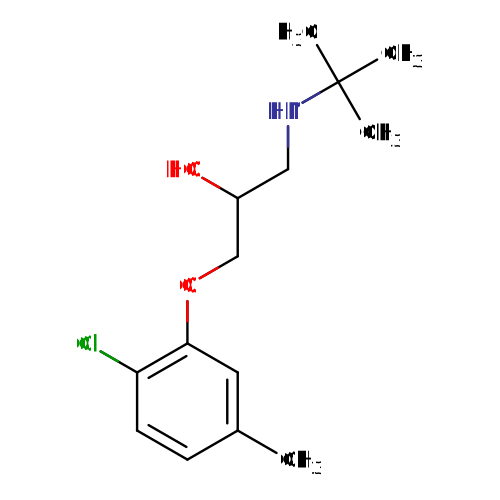
| Structure | CC1=CC(OCC(O)CNC(C)(C)C)=C(Cl)C=C1 InChI=1S/C14H22ClNO2/c1-10-5-6-12(15)13(7-10)18-9-11(17)8-16-14(2,3)4/h5-7,11,16-17H,8-9H2,1-4H3 |
|---|
| Synonyms | | Value | Source |
|---|
| BUPRANOLOL hydrochloride | HMDB | | KL-255 | HMDB | | BUPRANOL | HMDB | | b 1312 | HMDB | | Bupranololum | HMDB | | Desma brand OF bupranolol hydrochloride | HMDB | | Betadrenol | HMDB |
|
|---|
| Chemical Formula | C14H22ClNO2 |
|---|
| Average Molecular Weight | 271.783 |
|---|
| Monoisotopic Molecular Weight | 271.13390666 |
|---|
| IUPAC Name | 1-(tert-butylamino)-3-(2-chloro-5-methylphenoxy)propan-2-ol |
|---|
| Traditional Name | 1-(tert-butylamino)-3-(2-chloro-5-methylphenoxy)propan-2-ol |
|---|
| CAS Registry Number | 23284-25-5 |
|---|
| SMILES | CC1=CC(OCC(O)CNC(C)(C)C)=C(Cl)C=C1 |
|---|
| InChI Identifier | InChI=1S/C14H22ClNO2/c1-10-5-6-12(15)13(7-10)18-9-11(17)8-16-14(2,3)4/h5-7,11,16-17H,8-9H2,1-4H3 |
|---|
| InChI Key | HQIRNZOQPUAHHV-UHFFFAOYSA-N |
|---|
| Chemical Taxonomy |
|---|
| Description | Belongs to the class of organic compounds known as phenol ethers. These are aromatic compounds containing an ether group substituted with a benzene ring. |
|---|
| Kingdom | Organic compounds |
|---|
| Super Class | Benzenoids |
|---|
| Class | Phenol ethers |
|---|
| Sub Class | Not Available |
|---|
| Direct Parent | Phenol ethers |
|---|
| Alternative Parents | |
|---|
| Substituents | - Phenoxy compound
- Phenol ether
- Alkyl aryl ether
- Toluene
- Chlorobenzene
- Halobenzene
- Aryl chloride
- Aryl halide
- Monocyclic benzene moiety
- 1,2-aminoalcohol
- Secondary alcohol
- Secondary amine
- Secondary aliphatic amine
- Ether
- Organic oxygen compound
- Alcohol
- Organooxygen compound
- Organic nitrogen compound
- Hydrocarbon derivative
- Organopnictogen compound
- Amine
- Organonitrogen compound
- Organohalogen compound
- Organochloride
- Aromatic homomonocyclic compound
|
|---|
| Molecular Framework | Aromatic homomonocyclic compounds |
|---|
| External Descriptors | Not Available |
|---|
| Ontology |
|---|
| Physiological effect | Not Available |
|---|
| Disposition | |
|---|
| Process | |
|---|
| Role | Not Available |
|---|
| Physical Properties |
|---|
| State | Solid |
|---|
| Experimental Molecular Properties | | Property | Value | Reference |
|---|
| Melting Point | Not Available | Not Available | | Boiling Point | Not Available | Not Available | | Water Solubility | Not Available | Not Available | | LogP | Not Available | Not Available |
|
|---|
| Experimental Chromatographic Properties | Not Available |
|---|
| Predicted Molecular Properties | |
|---|
| Predicted Chromatographic Properties | Predicted Collision Cross SectionsPredicted Retention Times Underivatized| Chromatographic Method | Retention Time | Reference |
|---|
| Measured using a Waters Acquity ultraperformance liquid chromatography (UPLC) ethylene-bridged hybrid (BEH) C18 column (100 mm × 2.1 mm; 1.7 μmparticle diameter). Predicted by Afia on May 17, 2022. Predicted by Afia on May 17, 2022. | 4.74 minutes | 32390414 | | Predicted by Siyang on May 30, 2022 | 11.7444 minutes | 33406817 | | Predicted by Siyang using ReTip algorithm on June 8, 2022 | 2.7 minutes | 32390414 | | AjsUoB = Accucore 150 Amide HILIC with 10mM Ammonium Formate, 0.1% Formic Acid | 54.3 seconds | 40023050 | | Fem_Long = Waters ACQUITY UPLC HSS T3 C18 with Water:MeOH and 0.1% Formic Acid | 1525.2 seconds | 40023050 | | Fem_Lipids = Ascentis Express C18 with (60:40 water:ACN):(90:10 IPA:ACN) and 10mM NH4COOH + 0.1% Formic Acid | 265.5 seconds | 40023050 | | Life_Old = Waters ACQUITY UPLC BEH C18 with Water:(20:80 acetone:ACN) and 0.1% Formic Acid | 152.0 seconds | 40023050 | | Life_New = RP Waters ACQUITY UPLC HSS T3 C18 with Water:(30:70 MeOH:ACN) and 0.1% Formic Acid | 171.7 seconds | 40023050 | | RIKEN = Waters ACQUITY UPLC BEH C18 with Water:ACN and 0.1% Formic Acid | 93.1 seconds | 40023050 | | Eawag_XBridgeC18 = XBridge C18 3.5u 2.1x50 mm with Water:MeOH and 0.1% Formic Acid | 393.3 seconds | 40023050 | | BfG_NTS_RP1 =Agilent Zorbax Eclipse Plus C18 (2.1 mm x 150 mm, 3.5 um) with Water:ACN and 0.1% Formic Acid | 398.7 seconds | 40023050 | | HILIC_BDD_2 = Merck SeQuant ZIC-HILIC with ACN(0.1% formic acid):water(16 mM ammonium formate) | 76.0 seconds | 40023050 | | UniToyama_Atlantis = RP Waters Atlantis T3 (2.1 x 150 mm, 5 um) with ACN:Water and 0.1% Formic Acid | 821.5 seconds | 40023050 | | BDD_C18 = Hypersil Gold 1.9µm C18 with Water:ACN and 0.1% Formic Acid | 413.9 seconds | 40023050 | | UFZ_Phenomenex = Kinetex Core-Shell C18 2.6 um, 3.0 x 100 mm, Phenomenex with Water:MeOH and 0.1% Formic Acid | 1237.5 seconds | 40023050 | | SNU_RIKEN_POS = Waters ACQUITY UPLC BEH C18 with Water:ACN and 0.1% Formic Acid | 268.1 seconds | 40023050 | | RPMMFDA = Waters ACQUITY UPLC BEH C18 with Water:ACN and 0.1% Formic Acid | 304.8 seconds | 40023050 | | MTBLS87 = Merck SeQuant ZIC-pHILIC column with ACN:Water and :ammonium carbonate | 261.0 seconds | 40023050 | | KI_GIAR_zic_HILIC_pH2_7 = Merck SeQuant ZIC-HILIC with ACN:Water and 0.1% FA | 132.9 seconds | 40023050 | | Meister zic-pHILIC pH9.3 = Merck SeQuant ZIC-pHILIC column with ACN:Water 5mM NH4Ac pH9.3 and 5mM ammonium acetate in water | 8.0 seconds | 40023050 |
Predicted Kovats Retention IndicesUnderivatizedDerivatized| Derivative Name / Structure | SMILES | Kovats RI Value | Column Type | Reference |
|---|
| Bupranolol,1TMS,isomer #1 | CC1=CC=C(Cl)C(OCC(CNC(C)(C)C)O[Si](C)(C)C)=C1 | 1909.6 | Semi standard non polar | 33892256 | | Bupranolol,1TMS,isomer #2 | CC1=CC=C(Cl)C(OCC(O)CN(C(C)(C)C)[Si](C)(C)C)=C1 | 2121.1 | Semi standard non polar | 33892256 | | Bupranolol,2TMS,isomer #1 | CC1=CC=C(Cl)C(OCC(CN(C(C)(C)C)[Si](C)(C)C)O[Si](C)(C)C)=C1 | 2149.5 | Semi standard non polar | 33892256 | | Bupranolol,2TMS,isomer #1 | CC1=CC=C(Cl)C(OCC(CN(C(C)(C)C)[Si](C)(C)C)O[Si](C)(C)C)=C1 | 2181.8 | Standard non polar | 33892256 | | Bupranolol,2TMS,isomer #1 | CC1=CC=C(Cl)C(OCC(CN(C(C)(C)C)[Si](C)(C)C)O[Si](C)(C)C)=C1 | 2295.0 | Standard polar | 33892256 | | Bupranolol,1TBDMS,isomer #1 | CC1=CC=C(Cl)C(OCC(CNC(C)(C)C)O[Si](C)(C)C(C)(C)C)=C1 | 2141.4 | Semi standard non polar | 33892256 | | Bupranolol,1TBDMS,isomer #2 | CC1=CC=C(Cl)C(OCC(O)CN(C(C)(C)C)[Si](C)(C)C(C)(C)C)=C1 | 2377.5 | Semi standard non polar | 33892256 | | Bupranolol,2TBDMS,isomer #1 | CC1=CC=C(Cl)C(OCC(CN(C(C)(C)C)[Si](C)(C)C(C)(C)C)O[Si](C)(C)C(C)(C)C)=C1 | 2624.9 | Semi standard non polar | 33892256 | | Bupranolol,2TBDMS,isomer #1 | CC1=CC=C(Cl)C(OCC(CN(C(C)(C)C)[Si](C)(C)C(C)(C)C)O[Si](C)(C)C(C)(C)C)=C1 | 2602.3 | Standard non polar | 33892256 | | Bupranolol,2TBDMS,isomer #1 | CC1=CC=C(Cl)C(OCC(CN(C(C)(C)C)[Si](C)(C)C(C)(C)C)O[Si](C)(C)C(C)(C)C)=C1 | 2495.0 | Standard polar | 33892256 |
|
|---|
| GC-MS Spectra| Spectrum Type | Description | Splash Key | Deposition Date | Source | View |
|---|
| Predicted GC-MS | Predicted GC-MS Spectrum - Bupranolol GC-MS (Non-derivatized) - 70eV, Positive | splash10-0a4r-9410000000-4fb6e56fbfc20d328e01 | 2017-09-01 | Wishart Lab | View Spectrum | | Predicted GC-MS | Predicted GC-MS Spectrum - Bupranolol GC-MS (1 TMS) - 70eV, Positive | splash10-052r-9211000000-af03417e0faa422d8dab | 2017-10-06 | Wishart Lab | View Spectrum | | Predicted GC-MS | Predicted GC-MS Spectrum - Bupranolol GC-MS (Non-derivatized) - 70eV, Positive | Not Available | 2021-10-12 | Wishart Lab | View Spectrum | | Predicted GC-MS | Predicted GC-MS Spectrum - Bupranolol GC-MS (Non-derivatized) - 70eV, Positive | Not Available | 2021-10-12 | Wishart Lab | View Spectrum |
MS/MS Spectra| Spectrum Type | Description | Splash Key | Deposition Date | Source | View |
|---|
| Predicted LC-MS/MS | Predicted LC-MS/MS Spectrum - Bupranolol 10V, Positive-QTOF | splash10-00di-1390000000-a50fbc36e0a70a4174d0 | 2016-08-03 | Wishart Lab | View Spectrum | | Predicted LC-MS/MS | Predicted LC-MS/MS Spectrum - Bupranolol 20V, Positive-QTOF | splash10-00sd-7950000000-c35211adf59d6f487bc5 | 2016-08-03 | Wishart Lab | View Spectrum | | Predicted LC-MS/MS | Predicted LC-MS/MS Spectrum - Bupranolol 40V, Positive-QTOF | splash10-00du-9500000000-45c62fb606c1ef738a01 | 2016-08-03 | Wishart Lab | View Spectrum | | Predicted LC-MS/MS | Predicted LC-MS/MS Spectrum - Bupranolol 10V, Negative-QTOF | splash10-00dl-1690000000-1bcf21cb4e7773e99e3e | 2016-08-03 | Wishart Lab | View Spectrum | | Predicted LC-MS/MS | Predicted LC-MS/MS Spectrum - Bupranolol 20V, Negative-QTOF | splash10-0006-0900000000-87210d97bc0e2d6d0129 | 2016-08-03 | Wishart Lab | View Spectrum | | Predicted LC-MS/MS | Predicted LC-MS/MS Spectrum - Bupranolol 40V, Negative-QTOF | splash10-0006-2900000000-9864230af101317a562a | 2016-08-03 | Wishart Lab | View Spectrum | | Predicted LC-MS/MS | Predicted LC-MS/MS Spectrum - Bupranolol 10V, Positive-QTOF | splash10-00di-0090000000-0b8a6099373044013791 | 2021-10-11 | Wishart Lab | View Spectrum | | Predicted LC-MS/MS | Predicted LC-MS/MS Spectrum - Bupranolol 20V, Positive-QTOF | splash10-05fr-9830000000-68ae42e1fc1233fddace | 2021-10-11 | Wishart Lab | View Spectrum | | Predicted LC-MS/MS | Predicted LC-MS/MS Spectrum - Bupranolol 40V, Positive-QTOF | splash10-0a4i-8900000000-43ed85ee1afba8adfc07 | 2021-10-11 | Wishart Lab | View Spectrum | | Predicted LC-MS/MS | Predicted LC-MS/MS Spectrum - Bupranolol 10V, Negative-QTOF | splash10-0096-2930000000-ba5e95e24f16f97db432 | 2021-10-11 | Wishart Lab | View Spectrum | | Predicted LC-MS/MS | Predicted LC-MS/MS Spectrum - Bupranolol 20V, Negative-QTOF | splash10-0006-3900000000-a5db325c0590832c3c7d | 2021-10-11 | Wishart Lab | View Spectrum | | Predicted LC-MS/MS | Predicted LC-MS/MS Spectrum - Bupranolol 40V, Negative-QTOF | splash10-001i-9300000000-5ba3afed8bc3d8638c60 | 2021-10-11 | Wishart Lab | View Spectrum |
|
|---|