| Record Information |
|---|
| Version | 5.0 |
|---|
| Status | Expected but not Quantified |
|---|
| Creation Date | 2012-09-06 15:16:51 UTC |
|---|
| Update Date | 2022-03-07 02:51:49 UTC |
|---|
| HMDB ID | HMDB0015005 |
|---|
| Secondary Accession Numbers | |
|---|
| Metabolite Identification |
|---|
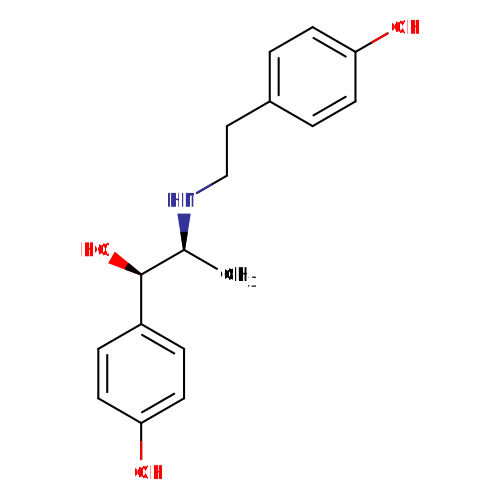
| Common Name | Ritodrine |
|---|
| Description | Ritodrine, also known as du-21220Ritodrine or prepar, belongs to the class of organic compounds known as phenethylamines. Phenethylamines are compounds containing a phenethylamine moiety, which consists of a phenyl group substituted at the second position by an ethan-1-amine. Ritodrine is a drug which is used for the treatment and prophylaxis of premature labour. This drug has been removed from the US market, according to FDA Orange Book. The passage of β agonists through the placenta does occur and may be responsible for fetal tachycardia, as well as hypoglycemia or hyperglycemia at birth. Ritodrine is a very strong basic compound (based on its pKa). Ritodrine (trade name Yutopar) is a tocolytic drug used to stop premature labor. Also, the 4-hydroxy group on the benzene ring is important for activity as it is needed to form hydrogen bonds. However, the 4-hydroxy group makes it susceptible to metabolism by catechol-O-methyl transferase (COMT). Since it is β2-selective it is used for premature labor. Most side effects of β2 agonists result from their concurrent β1 activity, and include increase in heart rate, rise in systolic pressure, decrease in diastolic pressure, chest pain secondary to myocardial infarction, and arrhythmia. Patients with type 2 diabetes, high blood pressure or migraines should bring this to their doctor's attention before receiving care. Since ritodrine has a bulky N-substituent, it has high β2 selectivity. |
|---|
| Structure | C[C@H](NCCC1=CC=C(O)C=C1)[C@H](O)C1=CC=C(O)C=C1 InChI=1S/C17H21NO3/c1-12(17(21)14-4-8-16(20)9-5-14)18-11-10-13-2-6-15(19)7-3-13/h2-9,12,17-21H,10-11H2,1H3/t12-,17-/m0/s1 |
|---|
| Synonyms | | Value | Source |
|---|
| DU-21220Ritodrine | HMDB | | PrePar | HMDB | | Astra brand OF ritodrine hydrochloride | HMDB | | Janssen brand OF ritodrine hydrochloride | HMDB | | Pre-par | HMDB | | Solvay brand OF ritodrine hydrochloride | HMDB | | Ritodrine hydrochloride | HMDB | | Hydrochloride, ritodrine | HMDB | | Pre par | HMDB | | Yutopar | HMDB |
|
|---|
| Chemical Formula | C17H21NO3 |
|---|
| Average Molecular Weight | 287.3535 |
|---|
| Monoisotopic Molecular Weight | 287.152143543 |
|---|
| IUPAC Name | 4-(2-{[(1R,2S)-1-hydroxy-1-(4-hydroxyphenyl)propan-2-yl]amino}ethyl)phenol |
|---|
| Traditional Name | PrePar |
|---|
| CAS Registry Number | 26652-09-5 |
|---|
| SMILES | C[C@H](NCCC1=CC=C(O)C=C1)[C@H](O)C1=CC=C(O)C=C1 |
|---|
| InChI Identifier | InChI=1S/C17H21NO3/c1-12(17(21)14-4-8-16(20)9-5-14)18-11-10-13-2-6-15(19)7-3-13/h2-9,12,17-21H,10-11H2,1H3/t12-,17-/m0/s1 |
|---|
| InChI Key | IOVGROKTTNBUGK-SJCJKPOMSA-N |
|---|
| Chemical Taxonomy |
|---|
| Description | Belongs to the class of organic compounds known as phenethylamines. Phenethylamines are compounds containing a phenethylamine moiety, which consists of a phenyl group substituted at the second position by an ethan-1-amine. |
|---|
| Kingdom | Organic compounds |
|---|
| Super Class | Benzenoids |
|---|
| Class | Benzene and substituted derivatives |
|---|
| Sub Class | Phenethylamines |
|---|
| Direct Parent | Phenethylamines |
|---|
| Alternative Parents | |
|---|
| Substituents | - Phenethylamine
- Phenylpropane
- Phenol
- 1-hydroxy-2-unsubstituted benzenoid
- Aralkylamine
- Secondary alcohol
- 1,2-aminoalcohol
- Secondary amine
- Secondary aliphatic amine
- Amine
- Aromatic alcohol
- Alcohol
- Organic nitrogen compound
- Organooxygen compound
- Organonitrogen compound
- Hydrocarbon derivative
- Organopnictogen compound
- Organic oxygen compound
- Aromatic homomonocyclic compound
|
|---|
| Molecular Framework | Aromatic homomonocyclic compounds |
|---|
| External Descriptors | |
|---|
| Ontology |
|---|
| Physiological effect | Not Available |
|---|
| Disposition | |
|---|
| Process | Not Available |
|---|
| Role | Not Available |
|---|
| Physical Properties |
|---|
| State | Solid |
|---|
| Experimental Molecular Properties | | Property | Value | Reference |
|---|
| Melting Point | 88 - 90 °C | Not Available | | Boiling Point | Not Available | Not Available | | Water Solubility | 0.18 g/L | Not Available | | LogP | 2.4 | Not Available |
|
|---|
| Experimental Chromatographic Properties | Experimental Collision Cross Sections |
|---|
| Predicted Molecular Properties | |
|---|
| Predicted Chromatographic Properties | Predicted Collision Cross SectionsPredicted Retention Times Underivatized| Chromatographic Method | Retention Time | Reference |
|---|
| Measured using a Waters Acquity ultraperformance liquid chromatography (UPLC) ethylene-bridged hybrid (BEH) C18 column (100 mm × 2.1 mm; 1.7 μmparticle diameter). Predicted by Afia on May 17, 2022. Predicted by Afia on May 17, 2022. | 3.21 minutes | 32390414 | | Predicted by Siyang on May 30, 2022 | 9.8158 minutes | 33406817 | | Predicted by Siyang using ReTip algorithm on June 8, 2022 | 4.7 minutes | 32390414 | | AjsUoB = Accucore 150 Amide HILIC with 10mM Ammonium Formate, 0.1% Formic Acid | 110.6 seconds | 40023050 | | Fem_Long = Waters ACQUITY UPLC HSS T3 C18 with Water:MeOH and 0.1% Formic Acid | 784.4 seconds | 40023050 | | Fem_Lipids = Ascentis Express C18 with (60:40 water:ACN):(90:10 IPA:ACN) and 10mM NH4COOH + 0.1% Formic Acid | 194.3 seconds | 40023050 | | Life_Old = Waters ACQUITY UPLC BEH C18 with Water:(20:80 acetone:ACN) and 0.1% Formic Acid | 134.1 seconds | 40023050 | | Life_New = RP Waters ACQUITY UPLC HSS T3 C18 with Water:(30:70 MeOH:ACN) and 0.1% Formic Acid | 158.7 seconds | 40023050 | | RIKEN = Waters ACQUITY UPLC BEH C18 with Water:ACN and 0.1% Formic Acid | 70.4 seconds | 40023050 | | Eawag_XBridgeC18 = XBridge C18 3.5u 2.1x50 mm with Water:MeOH and 0.1% Formic Acid | 312.3 seconds | 40023050 | | BfG_NTS_RP1 =Agilent Zorbax Eclipse Plus C18 (2.1 mm x 150 mm, 3.5 um) with Water:ACN and 0.1% Formic Acid | 290.7 seconds | 40023050 | | HILIC_BDD_2 = Merck SeQuant ZIC-HILIC with ACN(0.1% formic acid):water(16 mM ammonium formate) | 692.6 seconds | 40023050 | | UniToyama_Atlantis = RP Waters Atlantis T3 (2.1 x 150 mm, 5 um) with ACN:Water and 0.1% Formic Acid | 664.9 seconds | 40023050 | | BDD_C18 = Hypersil Gold 1.9µm C18 with Water:ACN and 0.1% Formic Acid | 253.9 seconds | 40023050 | | UFZ_Phenomenex = Kinetex Core-Shell C18 2.6 um, 3.0 x 100 mm, Phenomenex with Water:MeOH and 0.1% Formic Acid | 767.8 seconds | 40023050 | | SNU_RIKEN_POS = Waters ACQUITY UPLC BEH C18 with Water:ACN and 0.1% Formic Acid | 182.4 seconds | 40023050 | | RPMMFDA = Waters ACQUITY UPLC BEH C18 with Water:ACN and 0.1% Formic Acid | 225.6 seconds | 40023050 | | MTBLS87 = Merck SeQuant ZIC-pHILIC column with ACN:Water and :ammonium carbonate | 449.5 seconds | 40023050 | | KI_GIAR_zic_HILIC_pH2_7 = Merck SeQuant ZIC-HILIC with ACN:Water and 0.1% FA | 458.0 seconds | 40023050 | | Meister zic-pHILIC pH9.3 = Merck SeQuant ZIC-pHILIC column with ACN:Water 5mM NH4Ac pH9.3 and 5mM ammonium acetate in water | 60.1 seconds | 40023050 |
Predicted Kovats Retention IndicesUnderivatizedDerivatized| Derivative Name / Structure | SMILES | Kovats RI Value | Column Type | Reference |
|---|
| Ritodrine,1TMS,isomer #1 | C[C@H](NCCC1=CC=C(O[Si](C)(C)C)C=C1)[C@H](O)C1=CC=C(O)C=C1 | 2758.4 | Semi standard non polar | 33892256 | | Ritodrine,1TMS,isomer #2 | C[C@H](NCCC1=CC=C(O)C=C1)[C@H](O[Si](C)(C)C)C1=CC=C(O)C=C1 | 2817.5 | Semi standard non polar | 33892256 | | Ritodrine,1TMS,isomer #3 | C[C@H](NCCC1=CC=C(O)C=C1)[C@H](O)C1=CC=C(O[Si](C)(C)C)C=C1 | 2764.1 | Semi standard non polar | 33892256 | | Ritodrine,1TMS,isomer #4 | C[C@@H]([C@H](O)C1=CC=C(O)C=C1)N(CCC1=CC=C(O)C=C1)[Si](C)(C)C | 2868.5 | Semi standard non polar | 33892256 | | Ritodrine,2TMS,isomer #1 | C[C@H](NCCC1=CC=C(O[Si](C)(C)C)C=C1)[C@H](O[Si](C)(C)C)C1=CC=C(O)C=C1 | 2715.1 | Semi standard non polar | 33892256 | | Ritodrine,2TMS,isomer #2 | C[C@H](NCCC1=CC=C(O[Si](C)(C)C)C=C1)[C@H](O)C1=CC=C(O[Si](C)(C)C)C=C1 | 2711.9 | Semi standard non polar | 33892256 | | Ritodrine,2TMS,isomer #3 | C[C@@H]([C@H](O)C1=CC=C(O)C=C1)N(CCC1=CC=C(O[Si](C)(C)C)C=C1)[Si](C)(C)C | 2812.2 | Semi standard non polar | 33892256 | | Ritodrine,2TMS,isomer #4 | C[C@H](NCCC1=CC=C(O)C=C1)[C@H](O[Si](C)(C)C)C1=CC=C(O[Si](C)(C)C)C=C1 | 2706.9 | Semi standard non polar | 33892256 | | Ritodrine,2TMS,isomer #5 | C[C@@H]([C@H](O[Si](C)(C)C)C1=CC=C(O)C=C1)N(CCC1=CC=C(O)C=C1)[Si](C)(C)C | 2871.7 | Semi standard non polar | 33892256 | | Ritodrine,2TMS,isomer #6 | C[C@@H]([C@H](O)C1=CC=C(O[Si](C)(C)C)C=C1)N(CCC1=CC=C(O)C=C1)[Si](C)(C)C | 2832.7 | Semi standard non polar | 33892256 | | Ritodrine,3TMS,isomer #1 | C[C@H](NCCC1=CC=C(O[Si](C)(C)C)C=C1)[C@H](O[Si](C)(C)C)C1=CC=C(O[Si](C)(C)C)C=C1 | 2698.3 | Semi standard non polar | 33892256 | | Ritodrine,3TMS,isomer #2 | C[C@@H]([C@H](O[Si](C)(C)C)C1=CC=C(O)C=C1)N(CCC1=CC=C(O[Si](C)(C)C)C=C1)[Si](C)(C)C | 2775.2 | Semi standard non polar | 33892256 | | Ritodrine,3TMS,isomer #3 | C[C@@H]([C@H](O)C1=CC=C(O[Si](C)(C)C)C=C1)N(CCC1=CC=C(O[Si](C)(C)C)C=C1)[Si](C)(C)C | 2810.1 | Semi standard non polar | 33892256 | | Ritodrine,3TMS,isomer #4 | C[C@@H]([C@H](O[Si](C)(C)C)C1=CC=C(O[Si](C)(C)C)C=C1)N(CCC1=CC=C(O)C=C1)[Si](C)(C)C | 2781.2 | Semi standard non polar | 33892256 | | Ritodrine,4TMS,isomer #1 | C[C@@H]([C@H](O[Si](C)(C)C)C1=CC=C(O[Si](C)(C)C)C=C1)N(CCC1=CC=C(O[Si](C)(C)C)C=C1)[Si](C)(C)C | 2825.5 | Semi standard non polar | 33892256 | | Ritodrine,4TMS,isomer #1 | C[C@@H]([C@H](O[Si](C)(C)C)C1=CC=C(O[Si](C)(C)C)C=C1)N(CCC1=CC=C(O[Si](C)(C)C)C=C1)[Si](C)(C)C | 2574.6 | Standard non polar | 33892256 | | Ritodrine,4TMS,isomer #1 | C[C@@H]([C@H](O[Si](C)(C)C)C1=CC=C(O[Si](C)(C)C)C=C1)N(CCC1=CC=C(O[Si](C)(C)C)C=C1)[Si](C)(C)C | 2788.6 | Standard polar | 33892256 | | Ritodrine,1TBDMS,isomer #1 | C[C@H](NCCC1=CC=C(O[Si](C)(C)C(C)(C)C)C=C1)[C@H](O)C1=CC=C(O)C=C1 | 3035.9 | Semi standard non polar | 33892256 | | Ritodrine,1TBDMS,isomer #2 | C[C@H](NCCC1=CC=C(O)C=C1)[C@H](O[Si](C)(C)C(C)(C)C)C1=CC=C(O)C=C1 | 3077.9 | Semi standard non polar | 33892256 | | Ritodrine,1TBDMS,isomer #3 | C[C@H](NCCC1=CC=C(O)C=C1)[C@H](O)C1=CC=C(O[Si](C)(C)C(C)(C)C)C=C1 | 3045.2 | Semi standard non polar | 33892256 | | Ritodrine,1TBDMS,isomer #4 | C[C@@H]([C@H](O)C1=CC=C(O)C=C1)N(CCC1=CC=C(O)C=C1)[Si](C)(C)C(C)(C)C | 3127.7 | Semi standard non polar | 33892256 | | Ritodrine,2TBDMS,isomer #1 | C[C@H](NCCC1=CC=C(O[Si](C)(C)C(C)(C)C)C=C1)[C@H](O[Si](C)(C)C(C)(C)C)C1=CC=C(O)C=C1 | 3239.0 | Semi standard non polar | 33892256 | | Ritodrine,2TBDMS,isomer #2 | C[C@H](NCCC1=CC=C(O[Si](C)(C)C(C)(C)C)C=C1)[C@H](O)C1=CC=C(O[Si](C)(C)C(C)(C)C)C=C1 | 3273.3 | Semi standard non polar | 33892256 | | Ritodrine,2TBDMS,isomer #3 | C[C@@H]([C@H](O)C1=CC=C(O)C=C1)N(CCC1=CC=C(O[Si](C)(C)C(C)(C)C)C=C1)[Si](C)(C)C(C)(C)C | 3314.0 | Semi standard non polar | 33892256 | | Ritodrine,2TBDMS,isomer #4 | C[C@H](NCCC1=CC=C(O)C=C1)[C@H](O[Si](C)(C)C(C)(C)C)C1=CC=C(O[Si](C)(C)C(C)(C)C)C=C1 | 3215.0 | Semi standard non polar | 33892256 | | Ritodrine,2TBDMS,isomer #5 | C[C@@H]([C@H](O[Si](C)(C)C(C)(C)C)C1=CC=C(O)C=C1)N(CCC1=CC=C(O)C=C1)[Si](C)(C)C(C)(C)C | 3380.2 | Semi standard non polar | 33892256 | | Ritodrine,2TBDMS,isomer #6 | C[C@@H]([C@H](O)C1=CC=C(O[Si](C)(C)C(C)(C)C)C=C1)N(CCC1=CC=C(O)C=C1)[Si](C)(C)C(C)(C)C | 3341.3 | Semi standard non polar | 33892256 | | Ritodrine,3TBDMS,isomer #1 | C[C@H](NCCC1=CC=C(O[Si](C)(C)C(C)(C)C)C=C1)[C@H](O[Si](C)(C)C(C)(C)C)C1=CC=C(O[Si](C)(C)C(C)(C)C)C=C1 | 3425.1 | Semi standard non polar | 33892256 | | Ritodrine,3TBDMS,isomer #2 | C[C@@H]([C@H](O[Si](C)(C)C(C)(C)C)C1=CC=C(O)C=C1)N(CCC1=CC=C(O[Si](C)(C)C(C)(C)C)C=C1)[Si](C)(C)C(C)(C)C | 3547.4 | Semi standard non polar | 33892256 | | Ritodrine,3TBDMS,isomer #3 | C[C@@H]([C@H](O)C1=CC=C(O[Si](C)(C)C(C)(C)C)C=C1)N(CCC1=CC=C(O[Si](C)(C)C(C)(C)C)C=C1)[Si](C)(C)C(C)(C)C | 3609.8 | Semi standard non polar | 33892256 | | Ritodrine,3TBDMS,isomer #4 | C[C@@H]([C@H](O[Si](C)(C)C(C)(C)C)C1=CC=C(O[Si](C)(C)C(C)(C)C)C=C1)N(CCC1=CC=C(O)C=C1)[Si](C)(C)C(C)(C)C | 3528.9 | Semi standard non polar | 33892256 | | Ritodrine,4TBDMS,isomer #1 | C[C@@H]([C@H](O[Si](C)(C)C(C)(C)C)C1=CC=C(O[Si](C)(C)C(C)(C)C)C=C1)N(CCC1=CC=C(O[Si](C)(C)C(C)(C)C)C=C1)[Si](C)(C)C(C)(C)C | 3783.6 | Semi standard non polar | 33892256 | | Ritodrine,4TBDMS,isomer #1 | C[C@@H]([C@H](O[Si](C)(C)C(C)(C)C)C1=CC=C(O[Si](C)(C)C(C)(C)C)C=C1)N(CCC1=CC=C(O[Si](C)(C)C(C)(C)C)C=C1)[Si](C)(C)C(C)(C)C | 3313.6 | Standard non polar | 33892256 | | Ritodrine,4TBDMS,isomer #1 | C[C@@H]([C@H](O[Si](C)(C)C(C)(C)C)C1=CC=C(O[Si](C)(C)C(C)(C)C)C=C1)N(CCC1=CC=C(O[Si](C)(C)C(C)(C)C)C=C1)[Si](C)(C)C(C)(C)C | 3140.6 | Standard polar | 33892256 |
|
|---|
| GC-MS Spectra| Spectrum Type | Description | Splash Key | Deposition Date | Source | View |
|---|
| Predicted GC-MS | Predicted GC-MS Spectrum - Ritodrine GC-MS (Non-derivatized) - 70eV, Positive | splash10-00di-2900000000-3805a42a3d5fd6ba5125 | 2017-09-01 | Wishart Lab | View Spectrum | | Predicted GC-MS | Predicted GC-MS Spectrum - Ritodrine GC-MS (3 TMS) - 70eV, Positive | splash10-000i-3812900000-413b9134e83bd9eb68ea | 2017-10-06 | Wishart Lab | View Spectrum | | Predicted GC-MS | Predicted GC-MS Spectrum - Ritodrine GC-MS (Non-derivatized) - 70eV, Positive | Not Available | 2021-10-12 | Wishart Lab | View Spectrum |
MS/MS Spectra| Spectrum Type | Description | Splash Key | Deposition Date | Source | View |
|---|
| Predicted LC-MS/MS | Predicted LC-MS/MS Spectrum - Ritodrine 10V, Positive-QTOF | splash10-00dr-0290000000-02edb26ad804521cb8e4 | 2016-08-03 | Wishart Lab | View Spectrum | | Predicted LC-MS/MS | Predicted LC-MS/MS Spectrum - Ritodrine 20V, Positive-QTOF | splash10-00di-0950000000-0e89a0ff051f0d547e32 | 2016-08-03 | Wishart Lab | View Spectrum | | Predicted LC-MS/MS | Predicted LC-MS/MS Spectrum - Ritodrine 40V, Positive-QTOF | splash10-05fr-3900000000-a099c03cdf184ee84188 | 2016-08-03 | Wishart Lab | View Spectrum | | Predicted LC-MS/MS | Predicted LC-MS/MS Spectrum - Ritodrine 10V, Negative-QTOF | splash10-000i-0190000000-6866c99f3f35731b7230 | 2016-08-03 | Wishart Lab | View Spectrum | | Predicted LC-MS/MS | Predicted LC-MS/MS Spectrum - Ritodrine 20V, Negative-QTOF | splash10-00kr-0590000000-8f1447c41913cfe1e6a8 | 2016-08-03 | Wishart Lab | View Spectrum | | Predicted LC-MS/MS | Predicted LC-MS/MS Spectrum - Ritodrine 40V, Negative-QTOF | splash10-059f-2900000000-934b4f1329ef64eb84b7 | 2016-08-03 | Wishart Lab | View Spectrum | | Predicted LC-MS/MS | Predicted LC-MS/MS Spectrum - Ritodrine 10V, Positive-QTOF | splash10-00dr-0090000000-7e6adf998001bda28d4c | 2021-10-11 | Wishart Lab | View Spectrum | | Predicted LC-MS/MS | Predicted LC-MS/MS Spectrum - Ritodrine 20V, Positive-QTOF | splash10-0229-0940000000-539c88e27fcfbd0e43b9 | 2021-10-11 | Wishart Lab | View Spectrum | | Predicted LC-MS/MS | Predicted LC-MS/MS Spectrum - Ritodrine 40V, Positive-QTOF | splash10-00di-3910000000-ff359fb94fd092d0d974 | 2021-10-11 | Wishart Lab | View Spectrum | | Predicted LC-MS/MS | Predicted LC-MS/MS Spectrum - Ritodrine 10V, Negative-QTOF | splash10-000i-0090000000-3d5dafd780989d4c897a | 2021-10-11 | Wishart Lab | View Spectrum | | Predicted LC-MS/MS | Predicted LC-MS/MS Spectrum - Ritodrine 20V, Negative-QTOF | splash10-000i-0590000000-a01c09e2c4aaee3ee8a8 | 2021-10-11 | Wishart Lab | View Spectrum | | Predicted LC-MS/MS | Predicted LC-MS/MS Spectrum - Ritodrine 40V, Negative-QTOF | splash10-000x-5900000000-9f661b051730763b4d5b | 2021-10-11 | Wishart Lab | View Spectrum |
|
|---|