| Record Information |
|---|
| Version | 5.0 |
|---|
| Status | Expected but not Quantified |
|---|
| Creation Date | 2012-09-06 15:16:50 UTC |
|---|
| Update Date | 2022-03-07 02:51:46 UTC |
|---|
| HMDB ID | HMDB0014886 |
|---|
| Secondary Accession Numbers | |
|---|
| Metabolite Identification |
|---|
| Common Name | Carbinoxamine |
|---|
| Description | Carbinoxamine is a first generation antihistamine that competes with free histamine for binding at HA-receptor sites. This antagonizes the effects of histamine on HA-receptors, leading to a reduction of the negative symptoms brought on by histamine HA-receptor binding. The product label for carbinoxamine as an over the counter cough and cold medicine is being modified to state 'do not use' in children under 4 years of age in order to prevent and reduce misuse, as many unapproved carbinoxamine-containing preparations contained inappropriate labeling, which promoted unapproved uses (including management of congestion, cough, the common cold, and the use in children under 2 years of age), which can potentially cause serious health risks. |
|---|
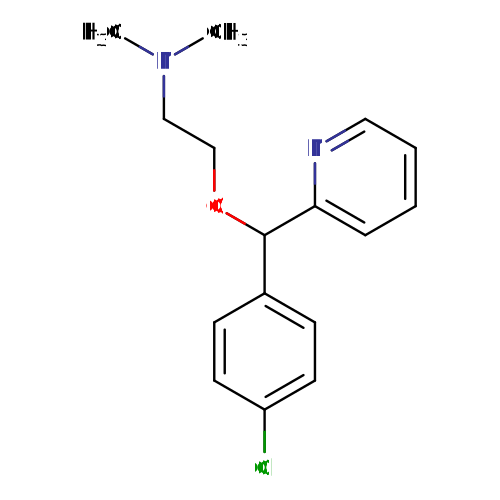
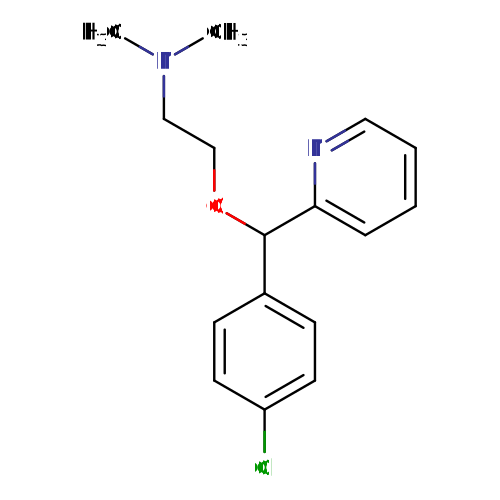
| Structure | CN(C)CCOC(C1=CC=C(Cl)C=C1)C1=CC=CC=N1 InChI=1S/C16H19ClN2O/c1-19(2)11-12-20-16(15-5-3-4-10-18-15)13-6-8-14(17)9-7-13/h3-10,16H,11-12H2,1-2H3 |
|---|
| Synonyms | | Value | Source |
|---|
| (+-)-Carbinoxamine | ChEBI | | 2-(p-Chloro-alpha-(2-(dimethylamino)ethoxy)benzyl)pyridine | ChEBI | | Carbinoxamina | ChEBI | | Carbinoxamine base | ChEBI | | Carbinoxaminum | ChEBI | | Paracarbinoxamine | ChEBI | | {2-[(4-chloro-phenyl)-pyridin-2-yl-methoxy]-ethyl}-dimethyl-amine | ChEBI | | 2-(p-Chloro-a-(2-(dimethylamino)ethoxy)benzyl)pyridine | Generator | | 2-(p-Chloro-α-(2-(dimethylamino)ethoxy)benzyl)pyridine | Generator | | Carbinoxamine maleate | HMDB | | Paracarinoxamine | HMDB | | Histex PD | HMDB | | Histex CT | HMDB | | Histex I-e | HMDB |
|
|---|
| Chemical Formula | C16H19ClN2O |
|---|
| Average Molecular Weight | 290.788 |
|---|
| Monoisotopic Molecular Weight | 290.118590947 |
|---|
| IUPAC Name | {2-[(4-chlorophenyl)(pyridin-2-yl)methoxy]ethyl}dimethylamine |
|---|
| Traditional Name | carbinoxamine |
|---|
| CAS Registry Number | 486-16-8 |
|---|
| SMILES | CN(C)CCOC(C1=CC=C(Cl)C=C1)C1=CC=CC=N1 |
|---|
| InChI Identifier | InChI=1S/C16H19ClN2O/c1-19(2)11-12-20-16(15-5-3-4-10-18-15)13-6-8-14(17)9-7-13/h3-10,16H,11-12H2,1-2H3 |
|---|
| InChI Key | OJFSXZCBGQGRNV-UHFFFAOYSA-N |
|---|
| Chemical Taxonomy |
|---|
| Description | Belongs to the class of organic compounds known as benzylethers. These are aromatic ethers with the general formula ROCR' (R = alkyl, aryl; R'=benzene). |
|---|
| Kingdom | Organic compounds |
|---|
| Super Class | Benzenoids |
|---|
| Class | Benzene and substituted derivatives |
|---|
| Sub Class | Benzylethers |
|---|
| Direct Parent | Benzylethers |
|---|
| Alternative Parents | |
|---|
| Substituents | - Benzylether
- Chlorobenzene
- Halobenzene
- Aryl chloride
- Aryl halide
- Pyridine
- Heteroaromatic compound
- Tertiary aliphatic amine
- Tertiary amine
- Dialkyl ether
- Ether
- Azacycle
- Organoheterocyclic compound
- Organohalogen compound
- Organic nitrogen compound
- Amine
- Hydrocarbon derivative
- Organopnictogen compound
- Organochloride
- Organonitrogen compound
- Organooxygen compound
- Organic oxygen compound
- Aromatic heteromonocyclic compound
|
|---|
| Molecular Framework | Aromatic heteromonocyclic compounds |
|---|
| External Descriptors | |
|---|
| Ontology |
|---|
| Physiological effect | Not Available |
|---|
| Disposition | |
|---|
| Process | |
|---|
| Role | |
|---|
| Physical Properties |
|---|
| State | Solid |
|---|
| Experimental Molecular Properties | | Property | Value | Reference |
|---|
| Melting Point | < 25 °C | Not Available | | Boiling Point | Not Available | Not Available | | Water Solubility | 0.23 g/L | Not Available | | LogP | 2.6 | Not Available |
|
|---|
| Experimental Chromatographic Properties | Experimental Collision Cross Sections |
|---|
| Predicted Molecular Properties | |
|---|
| Predicted Chromatographic Properties | Predicted Collision Cross SectionsPredicted Retention Times Underivatized| Chromatographic Method | Retention Time | Reference |
|---|
| Measured using a Waters Acquity ultraperformance liquid chromatography (UPLC) ethylene-bridged hybrid (BEH) C18 column (100 mm × 2.1 mm; 1.7 μmparticle diameter). Predicted by Afia on May 17, 2022. Predicted by Afia on May 17, 2022. | 4.85 minutes | 32390414 | | Predicted by Siyang on May 30, 2022 | 10.6978 minutes | 33406817 | | Predicted by Siyang using ReTip algorithm on June 8, 2022 | 2.76 minutes | 32390414 | | AjsUoB = Accucore 150 Amide HILIC with 10mM Ammonium Formate, 0.1% Formic Acid | 40.0 seconds | 40023050 | | Fem_Long = Waters ACQUITY UPLC HSS T3 C18 with Water:MeOH and 0.1% Formic Acid | 1669.6 seconds | 40023050 | | Fem_Lipids = Ascentis Express C18 with (60:40 water:ACN):(90:10 IPA:ACN) and 10mM NH4COOH + 0.1% Formic Acid | 245.3 seconds | 40023050 | | Life_Old = Waters ACQUITY UPLC BEH C18 with Water:(20:80 acetone:ACN) and 0.1% Formic Acid | 152.6 seconds | 40023050 | | Life_New = RP Waters ACQUITY UPLC HSS T3 C18 with Water:(30:70 MeOH:ACN) and 0.1% Formic Acid | 175.5 seconds | 40023050 | | RIKEN = Waters ACQUITY UPLC BEH C18 with Water:ACN and 0.1% Formic Acid | 147.4 seconds | 40023050 | | Eawag_XBridgeC18 = XBridge C18 3.5u 2.1x50 mm with Water:MeOH and 0.1% Formic Acid | 387.9 seconds | 40023050 | | BfG_NTS_RP1 =Agilent Zorbax Eclipse Plus C18 (2.1 mm x 150 mm, 3.5 um) with Water:ACN and 0.1% Formic Acid | 411.3 seconds | 40023050 | | HILIC_BDD_2 = Merck SeQuant ZIC-HILIC with ACN(0.1% formic acid):water(16 mM ammonium formate) | 217.3 seconds | 40023050 | | UniToyama_Atlantis = RP Waters Atlantis T3 (2.1 x 150 mm, 5 um) with ACN:Water and 0.1% Formic Acid | 922.9 seconds | 40023050 | | BDD_C18 = Hypersil Gold 1.9µm C18 with Water:ACN and 0.1% Formic Acid | 178.4 seconds | 40023050 | | UFZ_Phenomenex = Kinetex Core-Shell C18 2.6 um, 3.0 x 100 mm, Phenomenex with Water:MeOH and 0.1% Formic Acid | 1005.1 seconds | 40023050 | | SNU_RIKEN_POS = Waters ACQUITY UPLC BEH C18 with Water:ACN and 0.1% Formic Acid | 244.1 seconds | 40023050 | | RPMMFDA = Waters ACQUITY UPLC BEH C18 with Water:ACN and 0.1% Formic Acid | 292.1 seconds | 40023050 | | MTBLS87 = Merck SeQuant ZIC-pHILIC column with ACN:Water and :ammonium carbonate | 298.6 seconds | 40023050 | | KI_GIAR_zic_HILIC_pH2_7 = Merck SeQuant ZIC-HILIC with ACN:Water and 0.1% FA | 33.9 seconds | 40023050 | | Meister zic-pHILIC pH9.3 = Merck SeQuant ZIC-pHILIC column with ACN:Water 5mM NH4Ac pH9.3 and 5mM ammonium acetate in water | 7.8 seconds | 40023050 |
Predicted Kovats Retention IndicesUnderivatized |
|---|
| GC-MS Spectra| Spectrum Type | Description | Splash Key | Deposition Date | Source | View |
|---|
| Experimental GC-MS | GC-MS Spectrum - Carbinoxamine EI-B (Non-derivatized) | splash10-0ab9-9000000000-a413c068c7a879eb2068 | 2017-09-12 | HMDB team, MONA, MassBank | View Spectrum | | Experimental GC-MS | GC-MS Spectrum - Carbinoxamine EI-B (Non-derivatized) | splash10-0ab9-9000000000-a413c068c7a879eb2068 | 2018-05-18 | HMDB team, MONA, MassBank | View Spectrum | | Predicted GC-MS | Predicted GC-MS Spectrum - Carbinoxamine GC-MS (Non-derivatized) - 70eV, Positive | splash10-0pb9-9180000000-b7d95742727b1ef0a3c4 | 2017-09-01 | Wishart Lab | View Spectrum | | Predicted GC-MS | Predicted GC-MS Spectrum - Carbinoxamine GC-MS (Non-derivatized) - 70eV, Positive | Not Available | 2021-10-12 | Wishart Lab | View Spectrum | | MS | Mass Spectrum (Electron Ionization) | splash10-0ab9-9200000000-c3abf61d5cdaa81de77d | 2014-09-20 | Not Available | View Spectrum |
MS/MS Spectra| Spectrum Type | Description | Splash Key | Deposition Date | Source | View |
|---|
| Experimental LC-MS/MS | LC-MS/MS Spectrum - Carbinoxamine , positive-QTOF | splash10-0uxr-0490000000-9ece1371a4992f21aa52 | 2017-09-14 | HMDB team, MONA | View Spectrum | | Predicted LC-MS/MS | Predicted LC-MS/MS Spectrum - Carbinoxamine 10V, Positive-QTOF | splash10-0006-1090000000-eecfc1a96c21589df023 | 2016-06-03 | Wishart Lab | View Spectrum | | Predicted LC-MS/MS | Predicted LC-MS/MS Spectrum - Carbinoxamine 20V, Positive-QTOF | splash10-006x-4090000000-f55a8c538f446792b084 | 2016-06-03 | Wishart Lab | View Spectrum | | Predicted LC-MS/MS | Predicted LC-MS/MS Spectrum - Carbinoxamine 40V, Positive-QTOF | splash10-00di-9210000000-cc26b029a0e987b18446 | 2016-06-03 | Wishart Lab | View Spectrum | | Predicted LC-MS/MS | Predicted LC-MS/MS Spectrum - Carbinoxamine 10V, Negative-QTOF | splash10-000i-0090000000-dbe5de39fc21f0c12088 | 2016-08-03 | Wishart Lab | View Spectrum | | Predicted LC-MS/MS | Predicted LC-MS/MS Spectrum - Carbinoxamine 20V, Negative-QTOF | splash10-00kr-0190000000-757e5fdc2e3d83027d7a | 2016-08-03 | Wishart Lab | View Spectrum | | Predicted LC-MS/MS | Predicted LC-MS/MS Spectrum - Carbinoxamine 40V, Negative-QTOF | splash10-014i-7890000000-70eeab9a0ba6cc4b2449 | 2016-08-03 | Wishart Lab | View Spectrum | | Predicted LC-MS/MS | Predicted LC-MS/MS Spectrum - Carbinoxamine 10V, Positive-QTOF | splash10-0f6x-0090000000-8e6319ead8805445ce4f | 2021-10-11 | Wishart Lab | View Spectrum | | Predicted LC-MS/MS | Predicted LC-MS/MS Spectrum - Carbinoxamine 20V, Positive-QTOF | splash10-0udi-0090000000-b1b5900f97954c8ed449 | 2021-10-11 | Wishart Lab | View Spectrum | | Predicted LC-MS/MS | Predicted LC-MS/MS Spectrum - Carbinoxamine 40V, Positive-QTOF | splash10-0uk9-5090000000-c844f1f981eb3e25a3bf | 2021-10-11 | Wishart Lab | View Spectrum | | Predicted LC-MS/MS | Predicted LC-MS/MS Spectrum - Carbinoxamine 10V, Negative-QTOF | splash10-000i-0090000000-f8ccd79e440175ba372a | 2021-10-11 | Wishart Lab | View Spectrum | | Predicted LC-MS/MS | Predicted LC-MS/MS Spectrum - Carbinoxamine 20V, Negative-QTOF | splash10-0gb9-2190000000-37dda60416c010f365ad | 2021-10-11 | Wishart Lab | View Spectrum | | Predicted LC-MS/MS | Predicted LC-MS/MS Spectrum - Carbinoxamine 40V, Negative-QTOF | splash10-0gb9-4490000000-742d9da4f019f9a49ad2 | 2021-10-11 | Wishart Lab | View Spectrum |
|
|---|