| Record Information |
|---|
| Version | 5.0 |
|---|
| Status | Expected but not Quantified |
|---|
| Creation Date | 2012-09-06 15:16:49 UTC |
|---|
| Update Date | 2022-03-07 02:51:41 UTC |
|---|
| HMDB ID | HMDB0014613 |
|---|
| Secondary Accession Numbers | - HMDB0041865
- HMDB14613
- HMDB41865
|
|---|
| Metabolite Identification |
|---|
| Common Name | Tetrahydrocannabinol |
|---|
| Description | Tetrahydrocannabinol, abbreviated THC, is a cannabinoid identified in cannabis and is its principal psychoactive constituent. First isolated in 1964, in its pure form, it is a glassy solid when cold, and becomes viscous and sticky if warmed. Synthetically prepared THC, officially referred to by its INN, dronabinol, is available by prescription in the U.S. and Canada under the brand name Marinol. The mechanism of action of THC is not completely understood. It is thought that cannabinoid receptors in neural tissues may mediate the effects of cannabinoids. Animal studies suggest that Marinol's antiemetic effects may be due to inhibition of the vomiting control mechanism in the medulla oblongata. A literature review on the subject concluded that "Cannabis use appears to be neither a sufficient nor a necessary cause for psychosis. It is a component cause, part of a complex constellation of factors leading to psychosis." Likewise, a French review from 2009 came to a conclusion that cannabis use, particularly that before age 15, was a factor in the development of schizophrenic disorders. An aromatic terpenoid, THC has a very low solubility in water, but good solubility in most organic solvents, specifically lipids and alcohols. The presence of these specialized cannabinoid receptors in the brain led researchers to the discovery of endocannabinoids, such as anandamide and 2-arachidonoyl glyceride (2-AG). THC targets receptors in a manner far less selective than endocannabinoid molecules released during retrograde signalling, as the drug has a relatively low cannabinoid receptor efficacy and affinity. In populations of low cannabinoid receptor density, THC may act to antagonize endogenous agonists that possess greater receptor efficacy. THC is a lipophilic molecule and may bind non-specifically to a variety of receptors in the brain and body, such as adipose tissue. Dronabinol is only found in individuals that have used or taken this drug. It is extracted from the resin of Cannabis sativa (marijuana, hashish). The isomer delta-9-tetrahydrocannabinol is considered the most active form, producing the characteristic mood and perceptual changes associated with this compound. In the United States, Marinol has been rescheduled from Schedule II to Schedule III of the Controlled Substances Act in 1999, reflecting a finding that THC had a potential for abuse less than that of cocaine and heroin. As a Schedule III drug, it is available by prescription and is considered to be non-narcotic and to have a low risk of physical or mental dependence. Marinol has been approved by the U.S. Food and Drug Administration (FDA) in the treatment of anorexia in AIDS patients, as well as for refractory nausea and vomiting of patients undergoing chemotherapy, which has raised much controversy as to why natural THC is still a Schedule I drug. Efforts to get cannabis rescheduled as analogous to Marinol have not succeeded thus far. In April 2005, Canadian authorities approved the marketing of Sativex, a mouth spray for multiple sclerosis patients, who can use it to alleviate neuropathic pain and spasticity. Sativex contains tetrahydrocannabinol together with cannabidiol and is a preparation of whole cannabis rather than individual cannabinoids. It is marketed in Canada by GW Pharmaceuticals, being the first cannabis-based prescription drug in the world (in modern times). In addition, Sativex received European regulatory approval in 2010. An analog of dronabinol, nabilone, is available commercially in Canada under the trade name Cesamet, manufactured by Valeant Pharmaceuticals. Cesamet has also received FDA approval and began marketing in the U.S. in 2006. It is a Schedule II drug. |
|---|
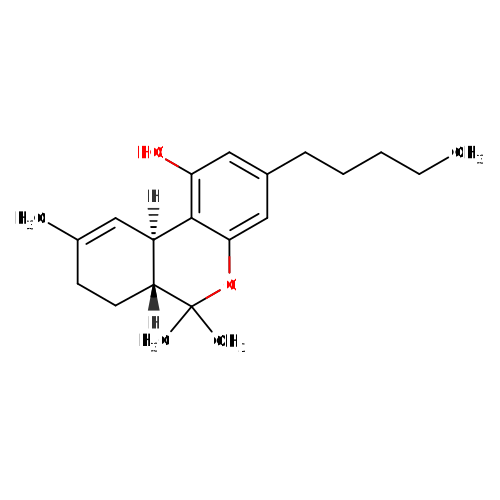
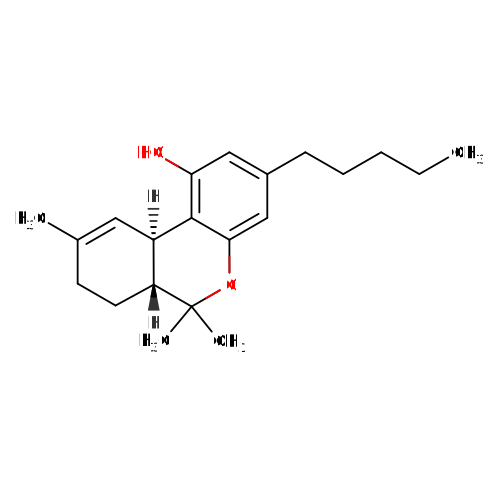
| Structure | [H][C@@]12C=C(C)CC[C@@]1([H])C(C)(C)OC1=CC(CCCCC)=CC(O)=C21 InChI=1S/C21H30O2/c1-5-6-7-8-15-12-18(22)20-16-11-14(2)9-10-17(16)21(3,4)23-19(20)13-15/h11-13,16-17,22H,5-10H2,1-4H3/t16-,17-/m1/s1 |
|---|
| Synonyms | | Value | Source |
|---|
| (-)-delta9-trans-Tetrahydrocannabinol | ChEBI | | 1-trans-delta-9-Tetrahydrocannabinol | ChEBI | | 3-Pentyl-6,6,9-trimethyl-6a,7,8,10a-tetrahydro-6H-dibenzo(b,D)pyran-1-ol | ChEBI | | 6,6,9-Trimethyl-3-pentyl-6a,7,8,10a-tetrahydro-6H-benzo[c]chromen-1-ol | ChEBI | | Delta(1)-Tetrahydrocannabinol | ChEBI | | delta9-Tetrahydrocannabinol | ChEBI | | Delta(9)-THC | ChEBI | | Dronabinol | ChEBI | | Dronabinolum | ChEBI | | Syndros | ChEBI | | THC | Kegg | | Marinol | Kegg | | (-)-Δ9-trans-tetrahydrocannabinol | Generator | | 1-trans-Δ-9-tetrahydrocannabinol | Generator | | Δ(1)-tetrahydrocannabinol | Generator | | Δ9-tetrahydrocannabinol | Generator | | Δ(9)-THC | Generator | | DELTA-9-THC | HMDB | | DELTA-9-TETRAHYDROCANNABINOL | HMDB | | Δ-9-THC | HMDB | | Δ-9-tetrahydrocannabinol | HMDB | | Tetrahydrocannabinol, (6a-trans)-isomer | HMDB | | 9-Ene-tetrahydrocannabinol | HMDB | | Tetrahydrocannabinol, (6ar-cis)-isomer | HMDB | | Tetrahydrocannabinol, (6as-cis)-isomer | HMDB | | Tetrahydrocannabinol, trans isomer | HMDB | | delta(9)-Tetrahydrocannabinol | HMDB | | delta(1)-THC | HMDB | | 9 Ene tetrahydrocannabinol | HMDB | | Solvay brand OF tetrahydrocannabinol | HMDB | | Tetrahydrocannabinol, trans-(+-)-isomer | HMDB | | Tetrahydrocannabinol, trans-isomer | HMDB | | delta 1-Tetrahydrocannabinol | HMDB | | (-)- delta 9-Tetrahydrocannabinol | HMDB | | (-)-delta 1-Tetrahydrocannabinol | HMDB | | (-)-delta 9-THC | HMDB | | (-)-delta 9-trans-Tetrahydrocannabinol | HMDB | | (-)-trans-delta 1-Tetrahydrocannabinol | HMDB | | (-)-trans-delta 9-Tetrahydrocannabinol | HMDB | | (-)-trans-delta 9-THC | HMDB | | (L)-delta 1-Tetrahydrocannabinol | HMDB | | 1-trans-delta 9-Tetrahydrocannabinol | HMDB | | 14C-delta 1-Tetrahydrocannabinol | HMDB | | delta 1-THC | HMDB | | delta 9-Tetrahydrocannabinol | HMDB | | delta 9-THC | HMDB | | delta 9-trans-Tetrahydrocannabinol | HMDB | | Exocyclic delta (9)(11)-tetrahydrocannabiol | HMDB | | L-delta 1-trans-Tetrahydrocannabinol | HMDB | | L-trans-delta 9-Tetrahydrocannabinol | HMDB | | Primolut | HMDB | | trans-delta (-)-9-Tetrahydrocannabinol | HMDB | | trans-delta 9-Tetrahydrocannabinol | HMDB | | Tetrahydrocannabinol | ChEBI | | (-)-3,4-trans-delta1-Tetrahydrocannabinol | PhytoBank | | (-)-3,4-trans-Δ1-Tetrahydrocannabinol | PhytoBank | | (-)-delta1-Tetrahydrocannabinol | PhytoBank | | (-)-delta9-THC | PhytoBank | | (-)-delta9-Tetrahydrocannabinol | PhytoBank | | (-)-trans-delta1-Tetrahydrocannabinol | PhytoBank | | (-)-trans-delta9-THC | PhytoBank | | (-)-trans-delta9-Tetrahydrocannabinol | PhytoBank | | (-)-trans-Δ1-Tetrahydrocannabinol | PhytoBank | | (-)-trans-Δ9-THC | PhytoBank | | (-)-trans-Δ9-Tetrahydrocannabinol | PhytoBank | | (-)-Δ1-Tetrahydrocannabinol | PhytoBank | | (-)-Δ9-THC | PhytoBank | | (-)-Δ9-Tetrahydrocannabinol | PhytoBank | | (l)-delta1-Tetrahydrocannabinol | PhytoBank | | (l)-Δ1-Tetrahydrocannabinol | PhytoBank | | delta1-THC | PhytoBank | | delta1-Tetrahydrocannabinol | PhytoBank | | delta9-THC | PhytoBank | | delta9-trans-Tetrahydrocannabinol | PhytoBank | | l-delta1-trans-Tetrahydrocannabinol | PhytoBank | | l-trans-delta9-Tetrahydrocannabinol | PhytoBank | | l-trans-Δ9-Tetrahydrocannabinol | PhytoBank | | l-Δ1-trans-Tetrahydrocannabinol | PhytoBank | | trans-(-)-delta9-Tetrahydrocannabinol | PhytoBank | | trans-(-)-Δ9-Tetrahydrocannabinol | PhytoBank | | trans-delta9-Tetrahydrocannabinol | PhytoBank | | trans-Δ9-Tetrahydrocannabinol | PhytoBank | | Δ1-THC | PhytoBank | | Δ1-Tetrahydrocannabinol | PhytoBank | | Δ9-THC | PhytoBank | | Δ9-trans-Tetrahydrocannabinol | PhytoBank |
|
|---|
| Chemical Formula | C21H30O2 |
|---|
| Average Molecular Weight | 314.4617 |
|---|
| Monoisotopic Molecular Weight | 314.224580204 |
|---|
| IUPAC Name | (6aR,10aR)-6,6,9-trimethyl-3-pentyl-6H,6aH,7H,8H,10aH-benzo[c]isochromen-1-ol |
|---|
| Traditional Name | THC |
|---|
| CAS Registry Number | 1972-08-3 |
|---|
| SMILES | [H][C@@]12C=C(C)CC[C@@]1([H])C(C)(C)OC1=CC(CCCCC)=CC(O)=C21 |
|---|
| InChI Identifier | InChI=1S/C21H30O2/c1-5-6-7-8-15-12-18(22)20-16-11-14(2)9-10-17(16)21(3,4)23-19(20)13-15/h11-13,16-17,22H,5-10H2,1-4H3/t16-,17-/m1/s1 |
|---|
| InChI Key | CYQFCXCEBYINGO-IAGOWNOFSA-N |
|---|
| Chemical Taxonomy |
|---|
| Description | Belongs to the class of organic compounds known as 2,2-dimethyl-1-benzopyrans. These are organic compounds containing a 1-benzopyran moiety that carries two methyl groups at the 2-position. |
|---|
| Kingdom | Organic compounds |
|---|
| Super Class | Organoheterocyclic compounds |
|---|
| Class | Benzopyrans |
|---|
| Sub Class | 1-benzopyrans |
|---|
| Direct Parent | 2,2-dimethyl-1-benzopyrans |
|---|
| Alternative Parents | |
|---|
| Substituents | - 2,2-dimethyl-1-benzopyran
- 1-hydroxy-4-unsubstituted benzenoid
- 1-hydroxy-2-unsubstituted benzenoid
- Alkyl aryl ether
- Benzenoid
- Oxacycle
- Ether
- Organic oxygen compound
- Hydrocarbon derivative
- Organooxygen compound
- Aromatic heteropolycyclic compound
|
|---|
| Molecular Framework | Aromatic heteropolycyclic compounds |
|---|
| External Descriptors | |
|---|
| Ontology |
|---|
| Physiological effect | Not Available |
|---|
| Disposition | |
|---|
| Process | Not Available |
|---|
| Role | Not Available |
|---|
| Physical Properties |
|---|
| State | Solid |
|---|
| Experimental Molecular Properties | | Property | Value | Reference |
|---|
| Melting Point | 200 °C | Not Available | | Boiling Point | Not Available | Not Available | | Water Solubility | 0.0026 g/L | Not Available | | LogP | 5.648 | Not Available |
|
|---|
| Experimental Chromatographic Properties | Not Available |
|---|
| Predicted Molecular Properties | |
|---|
| Predicted Chromatographic Properties | Predicted Collision Cross SectionsPredicted Retention Times Underivatized| Chromatographic Method | Retention Time | Reference |
|---|
| Measured using a Waters Acquity ultraperformance liquid chromatography (UPLC) ethylene-bridged hybrid (BEH) C18 column (100 mm × 2.1 mm; 1.7 μmparticle diameter). Predicted by Afia on May 17, 2022. Predicted by Afia on May 17, 2022. | 9.69 minutes | 32390414 | | Predicted by Siyang on May 30, 2022 | 23.5116 minutes | 33406817 | | Predicted by Siyang using ReTip algorithm on June 8, 2022 | 1.3 minutes | 32390414 | | Fem_Long = Waters ACQUITY UPLC HSS T3 C18 with Water:MeOH and 0.1% Formic Acid | 3121.3 seconds | 40023050 | | Fem_Lipids = Ascentis Express C18 with (60:40 water:ACN):(90:10 IPA:ACN) and 10mM NH4COOH + 0.1% Formic Acid | 752.8 seconds | 40023050 | | Life_Old = Waters ACQUITY UPLC BEH C18 with Water:(20:80 acetone:ACN) and 0.1% Formic Acid | 297.5 seconds | 40023050 | | Life_New = RP Waters ACQUITY UPLC HSS T3 C18 with Water:(30:70 MeOH:ACN) and 0.1% Formic Acid | 402.2 seconds | 40023050 | | RIKEN = Waters ACQUITY UPLC BEH C18 with Water:ACN and 0.1% Formic Acid | 540.3 seconds | 40023050 | | Eawag_XBridgeC18 = XBridge C18 3.5u 2.1x50 mm with Water:MeOH and 0.1% Formic Acid | 1212.1 seconds | 40023050 | | BfG_NTS_RP1 =Agilent Zorbax Eclipse Plus C18 (2.1 mm x 150 mm, 3.5 um) with Water:ACN and 0.1% Formic Acid | 1110.8 seconds | 40023050 | | HILIC_BDD_2 = Merck SeQuant ZIC-HILIC with ACN(0.1% formic acid):water(16 mM ammonium formate) | 98.1 seconds | 40023050 | | UniToyama_Atlantis = RP Waters Atlantis T3 (2.1 x 150 mm, 5 um) with ACN:Water and 0.1% Formic Acid | 2096.4 seconds | 40023050 | | BDD_C18 = Hypersil Gold 1.9µm C18 with Water:ACN and 0.1% Formic Acid | 748.7 seconds | 40023050 | | UFZ_Phenomenex = Kinetex Core-Shell C18 2.6 um, 3.0 x 100 mm, Phenomenex with Water:MeOH and 0.1% Formic Acid | 1988.4 seconds | 40023050 | | SNU_RIKEN_POS = Waters ACQUITY UPLC BEH C18 with Water:ACN and 0.1% Formic Acid | 776.9 seconds | 40023050 | | RPMMFDA = Waters ACQUITY UPLC BEH C18 with Water:ACN and 0.1% Formic Acid | 557.6 seconds | 40023050 | | MTBLS87 = Merck SeQuant ZIC-pHILIC column with ACN:Water and :ammonium carbonate | 508.5 seconds | 40023050 | | KI_GIAR_zic_HILIC_pH2_7 = Merck SeQuant ZIC-HILIC with ACN:Water and 0.1% FA | 619.1 seconds | 40023050 | | Meister zic-pHILIC pH9.3 = Merck SeQuant ZIC-pHILIC column with ACN:Water 5mM NH4Ac pH9.3 and 5mM ammonium acetate in water | 8.4 seconds | 40023050 |
Predicted Kovats Retention IndicesUnderivatizedDerivatized |
|---|
| GC-MS Spectra| Spectrum Type | Description | Splash Key | Deposition Date | Source | View |
|---|
| Predicted GC-MS | Predicted GC-MS Spectrum - Tetrahydrocannabinol GC-MS (Non-derivatized) - 70eV, Positive | splash10-0597-4090000000-670e40c1592b93325e44 | 2017-09-01 | Wishart Lab | View Spectrum | | Predicted GC-MS | Predicted GC-MS Spectrum - Tetrahydrocannabinol GC-MS (1 TMS) - 70eV, Positive | splash10-00dl-6009000000-735bce5abc1be2637810 | 2017-10-06 | Wishart Lab | View Spectrum | | Predicted GC-MS | Predicted GC-MS Spectrum - Tetrahydrocannabinol GC-MS (Non-derivatized) - 70eV, Positive | Not Available | 2021-10-12 | Wishart Lab | View Spectrum | | Predicted GC-MS | Predicted GC-MS Spectrum - Tetrahydrocannabinol GC-MS (Non-derivatized) - 70eV, Positive | Not Available | 2021-10-12 | Wishart Lab | View Spectrum | | MS | Mass Spectrum (Electron Ionization) | splash10-01pp-4792000000-06532e533cb7794b7c37 | 2014-09-20 | Not Available | View Spectrum |
MS/MS Spectra| Spectrum Type | Description | Splash Key | Deposition Date | Source | View |
|---|
| Experimental LC-MS/MS | LC-MS/MS Spectrum - Tetrahydrocannabinol Orbitrap 11V, positive-QTOF | splash10-014i-0219000000-1916f155ea706f1bfd78 | 2020-07-22 | HMDB team, MONA | View Spectrum | | Experimental LC-MS/MS | LC-MS/MS Spectrum - Tetrahydrocannabinol Orbitrap 15V, positive-QTOF | splash10-05mx-3943000000-9b0e61162051930e030f | 2020-07-22 | HMDB team, MONA | View Spectrum | | Experimental LC-MS/MS | LC-MS/MS Spectrum - Tetrahydrocannabinol Orbitrap 19V, positive-QTOF | splash10-052f-3920000000-06615e927292d6b78f04 | 2020-07-22 | HMDB team, MONA | View Spectrum | | Experimental LC-MS/MS | LC-MS/MS Spectrum - Tetrahydrocannabinol Orbitrap 25V, positive-QTOF | splash10-006x-5900000000-c44a1196b35ae31ac75c | 2020-07-22 | HMDB team, MONA | View Spectrum | | Experimental LC-MS/MS | LC-MS/MS Spectrum - Tetrahydrocannabinol Orbitrap 31V, positive-QTOF | splash10-00xu-7900000000-d06351b5900dfe483bd6 | 2020-07-22 | HMDB team, MONA | View Spectrum | | Experimental LC-MS/MS | LC-MS/MS Spectrum - Tetrahydrocannabinol Orbitrap 37V, positive-QTOF | splash10-00tf-9600000000-14d6a1649ef828de05e3 | 2020-07-22 | HMDB team, MONA | View Spectrum | | Experimental LC-MS/MS | LC-MS/MS Spectrum - Tetrahydrocannabinol Orbitrap 43V, positive-QTOF | splash10-00mo-9400000000-c1c5f46aa3925b6b440f | 2020-07-22 | HMDB team, MONA | View Spectrum | | Experimental LC-MS/MS | LC-MS/MS Spectrum - Tetrahydrocannabinol Orbitrap 50V, positive-QTOF | splash10-00ou-9300000000-fec356cc420b4d525c37 | 2020-07-22 | HMDB team, MONA | View Spectrum | | Experimental LC-MS/MS | LC-MS/MS Spectrum - Tetrahydrocannabinol Orbitrap 59V, positive-QTOF | splash10-016u-9200000000-295f54d67e0fa9512778 | 2020-07-22 | HMDB team, MONA | View Spectrum | | Experimental LC-MS/MS | LC-MS/MS Spectrum - Tetrahydrocannabinol Orbitrap 71V, positive-QTOF | splash10-0fvl-9200000000-92620f75edee11220267 | 2020-07-22 | HMDB team, MONA | View Spectrum | | Experimental LC-MS/MS | LC-MS/MS Spectrum - Tetrahydrocannabinol n/a 21V, positive-QTOF | splash10-053f-0980000000-c5e3986b120b13bf6cad | 2020-07-22 | HMDB team, MONA | View Spectrum | | Experimental LC-MS/MS | LC-MS/MS Spectrum - Tetrahydrocannabinol n/a 21V, positive-QTOF | splash10-00dr-0900000000-71e91d90ab20dda21879 | 2020-07-22 | HMDB team, MONA | View Spectrum | | Experimental LC-MS/MS | LC-MS/MS Spectrum - Tetrahydrocannabinol n/a 21V, positive-QTOF | splash10-0002-9000000000-0c6530b23f4594b0199d | 2020-07-22 | HMDB team, MONA | View Spectrum | | Experimental LC-MS/MS | LC-MS/MS Spectrum - Tetrahydrocannabinol n/a 21V, positive-QTOF | splash10-03di-0910000000-13e75d88a02fafe0bbe2 | 2020-07-22 | HMDB team, MONA | View Spectrum | | Experimental LC-MS/MS | LC-MS/MS Spectrum - Tetrahydrocannabinol n/a 21V, positive-QTOF | splash10-000j-0900000000-ae7ab2b9c0db456ba4d4 | 2020-07-22 | HMDB team, MONA | View Spectrum | | Experimental LC-MS/MS | LC-MS/MS Spectrum - Tetrahydrocannabinol n/a 21V, positive-QTOF | splash10-00lr-0490000000-aebf4a983943679cba93 | 2020-07-22 | HMDB team, MONA | View Spectrum | | Experimental LC-MS/MS | LC-MS/MS Spectrum - Tetrahydrocannabinol n/a 21V, positive-QTOF | splash10-004i-0910000000-13eb5c07bf46dbbbc6c3 | 2020-07-22 | HMDB team, MONA | View Spectrum | | Predicted LC-MS/MS | Predicted LC-MS/MS Spectrum - Tetrahydrocannabinol 10V, Positive-QTOF | splash10-014i-1239000000-dd0a437774bcd5f12cd9 | 2016-08-03 | Wishart Lab | View Spectrum | | Predicted LC-MS/MS | Predicted LC-MS/MS Spectrum - Tetrahydrocannabinol 20V, Positive-QTOF | splash10-0600-6291000000-48cdeee605af2033e358 | 2016-08-03 | Wishart Lab | View Spectrum | | Predicted LC-MS/MS | Predicted LC-MS/MS Spectrum - Tetrahydrocannabinol 40V, Positive-QTOF | splash10-0aou-9140000000-f6fc10c62a978b5bb9b0 | 2016-08-03 | Wishart Lab | View Spectrum | | Predicted LC-MS/MS | Predicted LC-MS/MS Spectrum - Tetrahydrocannabinol 10V, Negative-QTOF | splash10-03di-0009000000-1a8c2415357935328858 | 2016-08-03 | Wishart Lab | View Spectrum | | Predicted LC-MS/MS | Predicted LC-MS/MS Spectrum - Tetrahydrocannabinol 20V, Negative-QTOF | splash10-03di-0429000000-d0c2b14e825c4f547980 | 2016-08-03 | Wishart Lab | View Spectrum | | Predicted LC-MS/MS | Predicted LC-MS/MS Spectrum - Tetrahydrocannabinol 40V, Negative-QTOF | splash10-01re-3930000000-3f6ef979ec17030832a8 | 2016-08-03 | Wishart Lab | View Spectrum | | Predicted LC-MS/MS | Predicted LC-MS/MS Spectrum - Tetrahydrocannabinol 10V, Negative-QTOF | splash10-03di-0009000000-2514638890974c4f71f3 | 2021-09-23 | Wishart Lab | View Spectrum | | Predicted LC-MS/MS | Predicted LC-MS/MS Spectrum - Tetrahydrocannabinol 20V, Negative-QTOF | splash10-03di-0009000000-f9f1dddf06624032e0de | 2021-09-23 | Wishart Lab | View Spectrum |
|
|---|
| General References | - Gregg JM, Small EW, Moore R, Raft D, Toomey TC: Emotional response to intravenous delta9tetrahydrocannabinol during oral surgery. J Oral Surg. 1976 Apr;34(4):301-13. [PubMed:1062533 ]
- Schuel H, Burkman LJ: A tale of two cells: endocannabinoid-signaling regulates functions of neurons and sperm. Biol Reprod. 2005 Dec;73(6):1078-86. Epub 2005 Aug 24. [PubMed:16120829 ]
- Zhu W, Friedman H, Klein TW: Delta9-tetrahydrocannabinol induces apoptosis in macrophages and lymphocytes: involvement of Bcl-2 and caspase-1. J Pharmacol Exp Ther. 1998 Aug;286(2):1103-9. [PubMed:9694974 ]
- Zangen A, Solinas M, Ikemoto S, Goldberg SR, Wise RA: Two brain sites for cannabinoid reward. J Neurosci. 2006 May 3;26(18):4901-7. [PubMed:16672664 ]
- Consroe P, Martin P, Eisenstein D: Anticonvulsant drug antagonism of delta9tetrahydrocannabinol-induced seizures in rabbits. Res Commun Chem Pathol Pharmacol. 1977 Jan;16(1):1-13. [PubMed:841172 ]
- Concheiro M, de Castro A, Quintela O, Cruz A, Lopez-Rivadulla M: Development and validation of a method for the quantitation of Delta9tetrahydrocannabinol in oral fluid by liquid chromatography electrospray-mass-spectrometry. J Chromatogr B Analyt Technol Biomed Life Sci. 2004 Oct 25;810(2):319-24. [PubMed:15380731 ]
|
|---|