| Record Information |
|---|
| Version | 5.0 |
|---|
| Status | Detected and Quantified |
|---|
| Creation Date | 2008-12-10 02:05:40 UTC |
|---|
| Update Date | 2022-03-07 02:51:04 UTC |
|---|
| HMDB ID | HMDB0011211 |
|---|
| Secondary Accession Numbers | |
|---|
| Metabolite Identification |
|---|
| Common Name | PC(P-16:0/18:2(9Z,12Z)) |
|---|
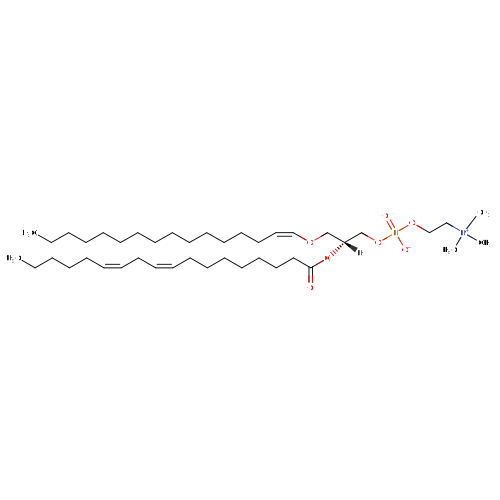
| Description | PC(P-16:0/18:2(9Z,12Z)) is a phosphatidylcholine (PC or GPCho). It is a glycerophospholipid in which a phosphorylcholine moiety occupies a glycerol substitution site. As is the case with diacylglycerols, glycerophosphocholines can have many different combinations of fatty acids of varying lengths and saturation attached at the C-1 and C-2 positions. Fatty acids containing 16, 18 and 20 carbons are the most common. PC(P-16:0/18:2(9Z,12Z)), in particular, consists of one chain of plasmalogen 16:0 at the C-1 position and one chain of linoleic acid at the C-2 position. The plasmalogen 16:0 moiety is derived from animal fats, liver and kidney, while the linoleic acid moiety is derived from seed oils. Phospholipids, are ubiquitous in nature and are key components of the lipid bilayer of cells, as well as being involved in metabolism and signaling. While most phospholipids have a saturated fatty acid on C-1 and an unsaturated fatty acid on C-2 of the glycerol backbone, the fatty acid distribution at the C-1 and C-2 positions of glycerol within phospholipids is continually in flux, owing to phospholipid degradation and the continuous phospholipid remodeling that occurs while these molecules are in membranes. PCs can be synthesized via three different routes. In one route, choline is activated first by phosphorylation and then by coupling to CDP prior to attachment to phosphatidic acid. PCs can also synthesized by the addition of choline to CDP-activated 1,2-diacylglycerol. A third route to PC synthesis involves the conversion of either PS or PE to PC. Plasmalogens are glycerol ether phospholipids. They are of two types, alkyl ether (-O-CH2-) and alkenyl ether (-O-CH=CH-). Dihydroxyacetone phosphate (DHAP) serves as the glycerol precursor for the synthesis of plasmalogens. Three major classes of plasmalogens have been identified: choline, ethanolamine and serine derivatives. Ethanolamine plasmalogen is prevalent in myelin. Choline plasmalogen is abundant in cardiac tissue. Usually, the highest proportion of the plasmalogen form is in the ethanolamine class with rather less in choline, and commonly little or none in other phospholipids such as phosphatidylinositol. In choline plasmalogens of most tissues, a higher proportion is often of the O-alkyl rather than the O-alkenyl form, but the reverse tends to be true in heart lipids. In animal tissues, the alkyl and alkenyl moieties in both non-polar and phospholipids tend to be rather simple in composition with 16:0, 18:0 and 18:1 (double bond in position 9) predominating. Ether analogues of triacylglycerols, i.e. 1-alkyldiacyl-sn-glycerols, are present at trace levels only if at all in most animal tissues, but they can be major components of some marine lipids. |
|---|
| Structure | |
|---|
| Synonyms | Not Available |
|---|
| Chemical Formula | C42H80NO7P |
|---|
| Average Molecular Weight | 742.0609 |
|---|
| Monoisotopic Molecular Weight | 741.567240431 |
|---|
| IUPAC Name | Not Available |
|---|
| Traditional Name | Not Available |
|---|
| CAS Registry Number | Not Available |
|---|
| SMILES | Not Available |
|---|
| InChI Identifier | InChI=1S/C42H80NO7P/c1-6-8-10-12-14-16-18-20-22-23-25-27-29-31-33-35-42(44)50-41(40-49-51(45,46)48-38-36-43(3,4)5)39-47-37-34-32-30-28-26-24-21-19-17-15-13-11-9-7-2/h14,16,20,22,34,37,41H,6-13,15,17-19,21,23-33,35-36,38-40H2,1-5H3/b16-14-,22-20-,37-34-/t41-/m1/s1 |
|---|
| InChI Key | QLEHHUPUHJPURI-PWYDUFMYSA-N |
|---|
| Chemical Taxonomy |
|---|
| Classification | Not classified |
|---|
| Ontology |
|---|
| Physiological effect | |
|---|
| Disposition | Biological locationSourceExogenous- Exogenous (HMDB: HMDB0011211)
FoodAnimal originMilk and milk productUnfermented milk- Cow milk, pasteurized, vitamin A + D added, 0% fat (FooDB: FOOD00889)
- Cow milk, pasteurized, vitamin A + D added, 1% fat (FooDB: FOOD00890)
- Cow milk, pasteurized, vitamin A + D added, 2% fat (FooDB: FOOD00891)
- Cow milk, pasteurized, vitamin D added, 3.25% fat (FooDB: FOOD00892)
Endogenous |
|---|
| Process | |
|---|
| Role | |
|---|
| Physical Properties |
|---|
| State | Solid |
|---|
| Experimental Molecular Properties | | Property | Value | Reference |
|---|
| Melting Point | Not Available | Not Available | | Boiling Point | Not Available | Not Available | | Water Solubility | Not Available | Not Available | | LogP | Not Available | Not Available |
|
|---|
| Experimental Chromatographic Properties |
|---|
| Predicted Molecular Properties | Not Available |
|---|
| Predicted Chromatographic Properties | Predicted Retention Times Underivatized| Chromatographic Method | Retention Time | Reference |
|---|
| Measured using a Waters Acquity ultraperformance liquid chromatography (UPLC) ethylene-bridged hybrid (BEH) C18 column (100 mm × 2.1 mm; 1.7 μmparticle diameter). Predicted by Afia on May 17, 2022. | 8.32 minutes | 32390414 | | Predicted by Siyang on May 30, 2022 | 38.5265 minutes | 33406817 | | Predicted by Siyang using ReTip algorithm on June 8, 2022 | 2.02 minutes | 32390414 | | AjsUoB = Accucore 150 Amide HILIC with 10mM Ammonium Formate, 0.1% Formic Acid | 79.5 seconds | 40023050 | | Fem_Long = Waters ACQUITY UPLC HSS T3 C18 with Water:MeOH and 0.1% Formic Acid | 5438.7 seconds | 40023050 | | Fem_Lipids = Ascentis Express C18 with (60:40 water:ACN):(90:10 IPA:ACN) and 10mM NH4COOH + 0.1% Formic Acid | 566.3 seconds | 40023050 | | Life_Old = Waters ACQUITY UPLC BEH C18 with Water:(20:80 acetone:ACN) and 0.1% Formic Acid | 391.5 seconds | 40023050 | | Life_New = RP Waters ACQUITY UPLC HSS T3 C18 with Water:(30:70 MeOH:ACN) and 0.1% Formic Acid | 293.2 seconds | 40023050 | | RIKEN = Waters ACQUITY UPLC BEH C18 with Water:ACN and 0.1% Formic Acid | 1189.0 seconds | 40023050 | | Eawag_XBridgeC18 = XBridge C18 3.5u 2.1x50 mm with Water:MeOH and 0.1% Formic Acid | 1969.7 seconds | 40023050 | | BfG_NTS_RP1 =Agilent Zorbax Eclipse Plus C18 (2.1 mm x 150 mm, 3.5 um) with Water:ACN and 0.1% Formic Acid | 1466.0 seconds | 40023050 | | HILIC_BDD_2 = Merck SeQuant ZIC-HILIC with ACN(0.1% formic acid):water(16 mM ammonium formate) | 348.0 seconds | 40023050 | | UniToyama_Atlantis = RP Waters Atlantis T3 (2.1 x 150 mm, 5 um) with ACN:Water and 0.1% Formic Acid | 4126.2 seconds | 40023050 | | BDD_C18 = Hypersil Gold 1.9µm C18 with Water:ACN and 0.1% Formic Acid | 1136.1 seconds | 40023050 | | UFZ_Phenomenex = Kinetex Core-Shell C18 2.6 um, 3.0 x 100 mm, Phenomenex with Water:MeOH and 0.1% Formic Acid | 3590.4 seconds | 40023050 | | SNU_RIKEN_POS = Waters ACQUITY UPLC BEH C18 with Water:ACN and 0.1% Formic Acid | 1270.2 seconds | 40023050 | | RPMMFDA = Waters ACQUITY UPLC BEH C18 with Water:ACN and 0.1% Formic Acid | 834.3 seconds | 40023050 | | MTBLS87 = Merck SeQuant ZIC-pHILIC column with ACN:Water and :ammonium carbonate | 375.6 seconds | 40023050 | | KI_GIAR_zic_HILIC_pH2_7 = Merck SeQuant ZIC-HILIC with ACN:Water and 0.1% FA | 540.2 seconds | 40023050 | | Meister zic-pHILIC pH9.3 = Merck SeQuant ZIC-pHILIC column with ACN:Water 5mM NH4Ac pH9.3 and 5mM ammonium acetate in water | 10.8 seconds | 40023050 |
Predicted Kovats Retention IndicesUnderivatized |
|---|
| Spectra |
|---|
| |
|---|
| Biological Properties |
|---|
| Cellular Locations | |
|---|
| Biospecimen Locations | |
|---|
| Tissue Locations | |
|---|
| Pathways | |
|---|
| Normal Concentrations |
|---|
| |
| Blood | Detected and Quantified | 413.3 +/- 69.2 uM | Adult (>18 years old) | Both | Normal | | details | | Blood | Detected and Quantified | 409.32(87.37) uM | Adult (>18 years old) | Both | Normal | | details | | Blood | Detected and Quantified | 315 (269-369) uM | Infant (0-1 year old) | Not Available | Normal | | details | | Blood | Detected and Quantified | 84.2 (71.2-101) uM | Newborn (0-30 days old) | Not Available | Normal | | details | | Feces | Detected and Quantified | 1.04 +/- 2.64 nmol/g wet feces | Adult (>18 years old) | Both | Normal | | details | | Feces | Detected and Quantified | 1.26 +/- 1.64 nmol/g wet feces | Adult (>18 years old) | Both | Normal | | details | | Saliva | Detected and Quantified | 0.187 +/- 0.090 uM | Adult (>18 years old) | Both | Normal | | details | | Urine | Detected and Quantified | 0.0047 (0.0016-0.024) umol/mmol creatinine | Adult (>18 years old) | Both | Normal | | details | | Urine | Detected and Quantified | 4.06 +/- 0.71 umol/mmol creatinine | Adolescent (13-18 years old) | Both | Normal | | details |
|
|---|
| Abnormal Concentrations |
|---|
| |
| Blood | Detected and Quantified | 284.991 (253.246) uM | Adult (>18 years old) | Female | Pregnancy with fetus having congenital heart defect | | details | | Blood | Detected and Quantified | 512.414 (109.171) uM | Adult (>18 years old) | Female | Pregnancy | | details | | Blood | Detected and Quantified | 342.12(78.53) uM | Adult (>18 years old) | Both | Heart failure with preserved ejection fraction | | details | | Blood | Detected and Quantified | 348.4(107.39) uM | Adult (>18 years old) | Both | Heart failure with reduced ejection fraction | | details | | Blood | Detected and Quantified | 293.9 +/- 67.9 uM | Children (1-13 years old) | Both | Obesity | | details | | Blood | Detected and Quantified | 342.3 +/- 95.3 uM | Children (1-13 years old) | Both | Obesity | | details | | Urine | Detected and Quantified | 2.57 +/- 0.24 umol/mmol creatinine | Adolescent (13-18 years old) | Both | Obese | | details |
|
|---|
| Predicted Concentrations |
|---|
| |
| Blood | 54.193 +/- 1.620 uM | Adult (>18 years old) | Both | Normal (Upper Limit) | Concentration data updated from parsing Nick's... | | Blood | 6.344 +/- 0.321 uM | Adult (>18 years old) | Both | Normal (Most Probable) | Concentration data updated from parsing Nick's... |
|
|---|
| Associated Disorders and Diseases |
|---|
| Disease References | | Pregnancy |
|---|
- Bahado-Singh RO, Ertl R, Mandal R, Bjorndahl TC, Syngelaki A, Han B, Dong E, Liu PB, Alpay-Savasan Z, Wishart DS, Nicolaides KH: Metabolomic prediction of fetal congenital heart defect in the first trimester. Am J Obstet Gynecol. 2014 Sep;211(3):240.e1-240.e14. doi: 10.1016/j.ajog.2014.03.056. Epub 2014 Apr 1. [PubMed:24704061 ]
| | Obesity |
|---|
- Cho K, Moon JS, Kang JH, Jang HB, Lee HJ, Park SI, Yu KS, Cho JY: Combined untargeted and targeted metabolomic profiling reveals urinary biomarkers for discriminating obese from normal-weight adolescents. Pediatr Obes. 2017 Apr;12(2):93-101. doi: 10.1111/ijpo.12114. Epub 2016 Feb 22. [PubMed:26910390 ]
- Simone Wahl, Christina Holzapfel, Zhonghao Yu, Michaela Breier, Ivan Kondofersky, Christiane Fuchs, Paula Singmann, Cornelia Prehn, Jerzy Adamski, Harald Grallert, Thomas Illig, Rui Wang-Sattler, Thomas Reinehr (2013). Metabolomics reveals determinants of weight loss during lifestyle intervention in obese children. Metabolomics.
|
|
|---|
| Associated OMIM IDs | |
|---|
| External Links |
|---|
| External Links | Not Available |
|---|
| References |
|---|
| Synthesis Reference | Not Available |
|---|
| Material Safety Data Sheet (MSDS) | Not Available |
|---|
| General References | - Simons K, Toomre D: Lipid rafts and signal transduction. Nat Rev Mol Cell Biol. 2000 Oct;1(1):31-9. [PubMed:11413487 ]
- Watson AD: Thematic review series: systems biology approaches to metabolic and cardiovascular disorders. Lipidomics: a global approach to lipid analysis in biological systems. J Lipid Res. 2006 Oct;47(10):2101-11. Epub 2006 Aug 10. [PubMed:16902246 ]
- Sethi JK, Vidal-Puig AJ: Thematic review series: adipocyte biology. Adipose tissue function and plasticity orchestrate nutritional adaptation. J Lipid Res. 2007 Jun;48(6):1253-62. Epub 2007 Mar 20. [PubMed:17374880 ]
- Lingwood D, Simons K: Lipid rafts as a membrane-organizing principle. Science. 2010 Jan 1;327(5961):46-50. doi: 10.1126/science.1174621. [PubMed:20044567 ]
- Divecha N, Irvine RF: Phospholipid signaling. Cell. 1995 Jan 27;80(2):269-78. [PubMed:7834746 ]
- Cevc, Gregor (1993). Phospholipids Handbook. Marcel Dekker.
- Gunstone, Frank D., John L. Harwood, and Albert J. Dijkstra (2007). The lipid handbook with CD-ROM. CRC Press.
|
|---|