Hmdb loader
Record Information
Version5.0
StatusExpected but not Quantified
Creation Date2005-11-16 15:48:42 UTC
Update Date2022-03-07 02:49:08 UTC
HMDB IDHMDB0001011
Secondary Accession Numbers
  • HMDB01011
Metabolite Identification
Common NameMethacrylyl-CoA
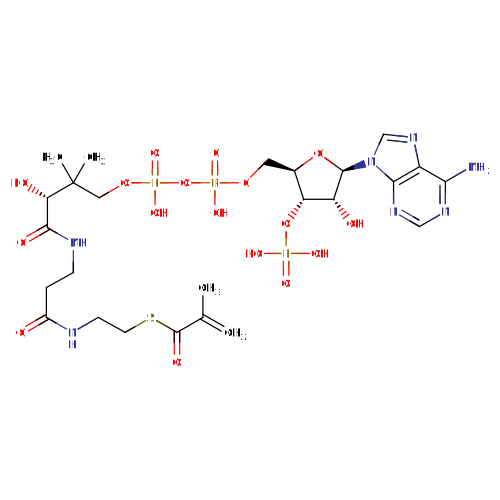
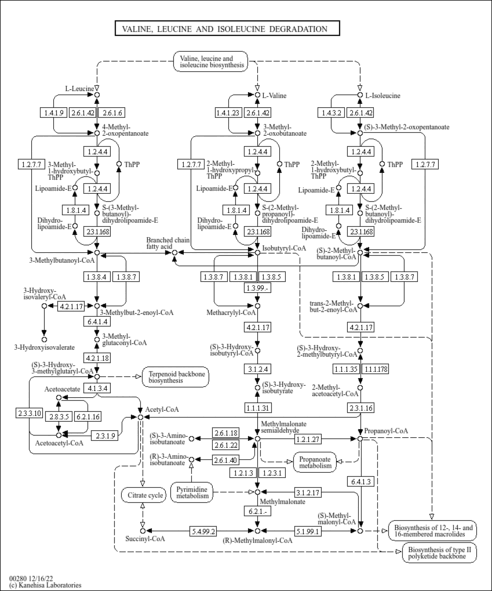
DescriptionMethacrylyl-CoA, also known as methacryloyl-CoA, belongs to the class of organic compounds known as organic pyrophosphates. These are organic compounds containing the pyrophosphate oxoanion, with the structure OP([O-])(=O)OP(O)([O-])=O. Thus, methacrylyl-CoA is considered to be a fatty ester lipid molecule. Methacrylyl-CoA is a very hydrophobic molecule, practically insoluble (in water), and relatively neutral. Methacrylyl-CoA has been detected, but not quantified in, several different foods, such as beechnuts, hyacinth beans, devilfish, eggplants, and cupuaçus. This could make methacrylyl-CoA a potential biomarker for the consumption of these foods. Methacrylyl-CoA is a metabolite in the valine, leucine, and isoleucine degradation pathway and highly reacts with free thiol compounds (PMID: 14684172 ). Cirrhosis results in a significant decrease in 3-hydroxyisobutyryl-CoA hydrolase activity, a key enzyme in the valine catabolic pathway that plays an important role in the catabolism of a potentially toxic compound, methacrylyl-CoA, formed as an intermediate in the catabolism of valine and isobutyrate (PMID: 8938168 ).
Structure
Data?1588001530
SynonymsNot Available
Chemical FormulaC25H40N7O17P3S
Average Molecular Weight835.608
Monoisotopic Molecular Weight835.141423115
IUPAC NameNot Available
Traditional NameNot Available
CAS Registry Number6008-91-9
SMILESNot Available
InChI Identifier
InChI=1S/C25H40N7O17P3S/c1-13(2)24(37)53-8-7-27-15(33)5-6-28-22(36)19(35)25(3,4)10-46-52(43,44)49-51(41,42)45-9-14-18(48-50(38,39)40)17(34)23(47-14)32-12-31-16-20(26)29-11-30-21(16)32/h11-12,14,17-19,23,34-35H,1,5-10H2,2-4H3,(H,27,33)(H,28,36)(H,41,42)(H,43,44)(H2,26,29,30)(H2,38,39,40)/t14-,17-,18-,19+,23-/m1/s1
InChI KeyNPALUEYCDZWBOV-NDZSKPAWSA-N
Chemical Taxonomy
ClassificationNot classified
Ontology
Physiological effectNot Available
Disposition
Biological locationRoute of exposureSource
Process
Role
Physical Properties
StateSolid
Experimental Molecular Properties
PropertyValueReference
Melting PointNot AvailableNot Available
Boiling PointNot AvailableNot Available
Water SolubilityNot AvailableNot Available
LogPNot AvailableNot Available
Experimental Chromatographic Properties
Predicted Molecular PropertiesNot Available
Predicted Chromatographic Properties

Predicted Retention Times

Underivatized

Chromatographic MethodRetention TimeReference
Measured using a Waters Acquity ultraperformance liquid chromatography (UPLC) ethylene-bridged hybrid (BEH) C18 column (100 mm × 2.1 mm; 1.7 μmparticle diameter). Predicted by Afia on May 17, 2022. Predicted by Afia on May 17, 2022.3.34 minutes32390414
Predicted by Siyang on May 30, 202210.1181 minutes33406817
Predicted by Siyang using ReTip algorithm on June 8, 20229.3 minutes32390414
AjsUoB = Accucore 150 Amide HILIC with 10mM Ammonium Formate, 0.1% Formic Acid513.8 seconds40023050
Fem_Long = Waters ACQUITY UPLC HSS T3 C18 with Water:MeOH and 0.1% Formic Acid1204.5 seconds40023050
Fem_Lipids = Ascentis Express C18 with (60:40 water:ACN):(90:10 IPA:ACN) and 10mM NH4COOH + 0.1% Formic Acid166.0 seconds40023050
Life_Old = Waters ACQUITY UPLC BEH C18 with Water:(20:80 acetone:ACN) and 0.1% Formic Acid97.3 seconds40023050
Life_New = RP Waters ACQUITY UPLC HSS T3 C18 with Water:(30:70 MeOH:ACN) and 0.1% Formic Acid162.5 seconds40023050
RIKEN = Waters ACQUITY UPLC BEH C18 with Water:ACN and 0.1% Formic Acid77.1 seconds40023050
Eawag_XBridgeC18 = XBridge C18 3.5u 2.1x50 mm with Water:MeOH and 0.1% Formic Acid352.7 seconds40023050
BfG_NTS_RP1 =Agilent Zorbax Eclipse Plus C18 (2.1 mm x 150 mm, 3.5 um) with Water:ACN and 0.1% Formic Acid441.4 seconds40023050
HILIC_BDD_2 = Merck SeQuant ZIC-HILIC with ACN(0.1% formic acid):water(16 mM ammonium formate)782.3 seconds40023050
UniToyama_Atlantis = RP Waters Atlantis T3 (2.1 x 150 mm, 5 um) with ACN:Water and 0.1% Formic Acid648.2 seconds40023050
BDD_C18 = Hypersil Gold 1.9µm C18 with Water:ACN and 0.1% Formic Acid324.2 seconds40023050
UFZ_Phenomenex = Kinetex Core-Shell C18 2.6 um, 3.0 x 100 mm, Phenomenex with Water:MeOH and 0.1% Formic Acid671.9 seconds40023050
SNU_RIKEN_POS = Waters ACQUITY UPLC BEH C18 with Water:ACN and 0.1% Formic Acid215.8 seconds40023050
RPMMFDA = Waters ACQUITY UPLC BEH C18 with Water:ACN and 0.1% Formic Acid225.5 seconds40023050
MTBLS87 = Merck SeQuant ZIC-pHILIC column with ACN:Water and :ammonium carbonate473.7 seconds40023050
KI_GIAR_zic_HILIC_pH2_7 = Merck SeQuant ZIC-HILIC with ACN:Water and 0.1% FA346.3 seconds40023050
Meister zic-pHILIC pH9.3 = Merck SeQuant ZIC-pHILIC column with ACN:Water 5mM NH4Ac pH9.3 and 5mM ammonium acetate in water384.5 seconds40023050

Predicted Kovats Retention Indices

Underivatized

MetaboliteSMILESKovats RI ValueColumn TypeReference
Methacrylyl-CoACC(=C)C(=O)SCCNC(=O)CCNC(=O)[C@H](O)C(C)(C)COP(O)(=O)OP(O)(=O)OC[C@H]1O[C@H]([C@H](O)[C@@H]1OP(O)(O)=O)N1C=NC2=C1N=CN=C2N5885.2Standard polar33892256
Methacrylyl-CoACC(=C)C(=O)SCCNC(=O)CCNC(=O)[C@H](O)C(C)(C)COP(O)(=O)OP(O)(=O)OC[C@H]1O[C@H]([C@H](O)[C@@H]1OP(O)(O)=O)N1C=NC2=C1N=CN=C2N4214.9Standard non polar33892256
Methacrylyl-CoACC(=C)C(=O)SCCNC(=O)CCNC(=O)[C@H](O)C(C)(C)COP(O)(=O)OP(O)(=O)OC[C@H]1O[C@H]([C@H](O)[C@@H]1OP(O)(O)=O)N1C=NC2=C1N=CN=C2N6401.4Semi standard non polar33892256
Spectra
Biological Properties
Cellular Locations
  • Extracellular
  • Membrane
  • Mitochondria
Biospecimen LocationsNot Available
Tissue LocationsNot Available
Pathways
Normal Concentrations
Not Available
Abnormal Concentrations
Not Available
Associated Disorders and Diseases
Disease ReferencesNone
Associated OMIM IDsNone
External LinksNot Available
References
Synthesis ReferenceHawes, John W.; Harper, Edwin T. Synthesis of methacrylyl-CoA and (R)- and (S)-3-hydroxyisobutyryl-CoA. Methods in Enzymology (2
Material Safety Data Sheet (MSDS)Not Available
General References
  1. Shimomura Y, Honda T, Goto H, Nonami T, Kurokawa T, Nagasaki M, Murakami T: Effects of liver failure on the enzymes in the branched-chain amino acid catabolic pathway. Biochem Biophys Res Commun. 2004 Jan 9;313(2):381-5. [PubMed:14684172 ]
  2. Lehnert W, Sass JO: Glutaconyl-CoA is the main toxic agent in glutaryl-CoA dehydrogenase deficiency (glutaric aciduria type I). Med Hypotheses. 2005;65(2):330-3. [PubMed:15922108 ]
  3. Taniguchi K, Nonami T, Nakao A, Harada A, Kurokawa T, Sugiyama S, Fujitsuka N, Shimomura Y, Hutson SM, Harris RA, Takagi H: The valine catabolic pathway in human liver: effect of cirrhosis on enzyme activities. Hepatology. 1996 Dec;24(6):1395-8. [PubMed:8938168 ]

Enzymes

General function:
Involved in acyl-CoA dehydrogenase activity
Specific function:
Not Available
Gene Name:
ACADS
Uniprot ID:
P16219
Molecular weight:
44296.705
Reactions
Isobutyryl-CoA + Acceptor → Methacrylyl-CoA + Reduced acceptordetails
General function:
Involved in acyl-CoA dehydrogenase activity
Specific function:
This enzyme is specific for acyl chain lengths of 4 to 16.
Gene Name:
ACADM
Uniprot ID:
P11310
Molecular weight:
46587.98
Reactions
Isobutyryl-CoA + Acceptor → Methacrylyl-CoA + Reduced acceptordetails
General function:
Involved in oxidoreductase activity
Specific function:
Not Available
Gene Name:
EHHADH
Uniprot ID:
Q08426
Molecular weight:
69153.26
Reactions
Methacrylyl-CoA + Water → (S)-3-Hydroxyisobutyryl-CoAdetails
General function:
Involved in catalytic activity
Specific function:
Straight-chain enoyl-CoA thioesters from C4 up to at least C16 are processed, although with decreasing catalytic rate.
Gene Name:
ECHS1
Uniprot ID:
P30084
Molecular weight:
31387.085
Reactions
Methacrylyl-CoA + Water → (S)-3-Hydroxyisobutyryl-CoAdetails
General function:
Involved in oxidoreductase activity
Specific function:
Bifunctional subunit.
Gene Name:
HADHA
Uniprot ID:
P40939
Molecular weight:
82998.97
Reactions
Methacrylyl-CoA + Water → (S)-3-Hydroxyisobutyryl-CoAdetails
General function:
Involved in acyl-CoA dehydrogenase activity
Specific function:
Has greatest activity toward short branched chain acyl-CoA derivative such as (s)-2-methylbutyryl-CoA, isobutyryl-CoA, and 2-methylhexanoyl-CoA as well as toward short straight chain acyl-CoAs such as butyryl-CoA and hexanoyl-CoA. Can use valproyl-CoA as substrate and may play a role in controlling the metabolic flux of valproic acid in the development of toxicity of this agent.
Gene Name:
ACADSB
Uniprot ID:
P45954
Molecular weight:
47485.035
Reactions
Isobutyryl-CoA + Acceptor → Methacrylyl-CoA + Reduced acceptordetails
General function:
Involved in acyl-CoA dehydrogenase activity
Specific function:
Has very high activity toward isobutyryl-CoA. Is an isobutyryl-CoA dehydrogenase that functions in valine catabolism. Plays a role in transcriptional coactivation within the ARC complex.
Gene Name:
ACAD8
Uniprot ID:
Q9UKU7
Molecular weight:
45069.39
Reactions
Isobutyryl-CoA + Acceptor → Methacrylyl-CoA + Reduced acceptordetails